






A hospital website is often the first point of contact between patients and your hospital. Patients search online before making decisions. Effective hospital website design can influence trust, credibility, and their decision to choose your hospital for care.
Using thoughtful hospital website design and medical website design best practices, you can create health-related websites that reflect professionalism, compassion and patient-centric care. Whether building anew or redesigning an existing site, focusing on the right elements can help you become one of the best hospital websites online.
Why Hospital Website Design Matters
Increasingly people rely on the internet first when searching for health information or care providers. In fact, a large survey found that nearly half of adults reported going online first when looking for health or medical information rather than directly contacting a physician.
This shift means that a hospital’s online presence carries a major influence on patient decisions. A trustworthy, clear, and well-designed website signals professionalism and can reduce anxiety, especially for patients or families seeking care.
Further, research on web-based health information shows many sites vary widely in quality; poor design, inconsistent information or complicated navigation can reduce engagement or even misinform patients.
Therefore, investing in robust medical website design is not optional; it is a necessity for any hospital that wants to build trust and attract patients.
Essential Features of a Successful Hospital Website
A successful hospital website includes must-have features that help patients quickly find the information and support they need with ease.
1. Clear and Simple Navigation
Patients should find vital information in seconds. A clean, intuitive layout with easy-to-navigate menus for departments, treatments, doctors, contact information, and appointment booking is key. Cluttered or confusing websites are a major barrier, especially for patients who may be in stress or urgency.
Good hospital website design ensures that important pages like treatments, specialities, doctors, contact / location, and booking are accessible from the main navigation without deep digging.
2. Visible Doctor Profiles, Specialities and Services
For medical website design to build trust, patients should quickly know who the doctors are, what specialities and treatments are available, and how to book. Include:
- Doctor bios (experience, qualifications)
- List of services and specialities
- Clear calls to schedule appointments
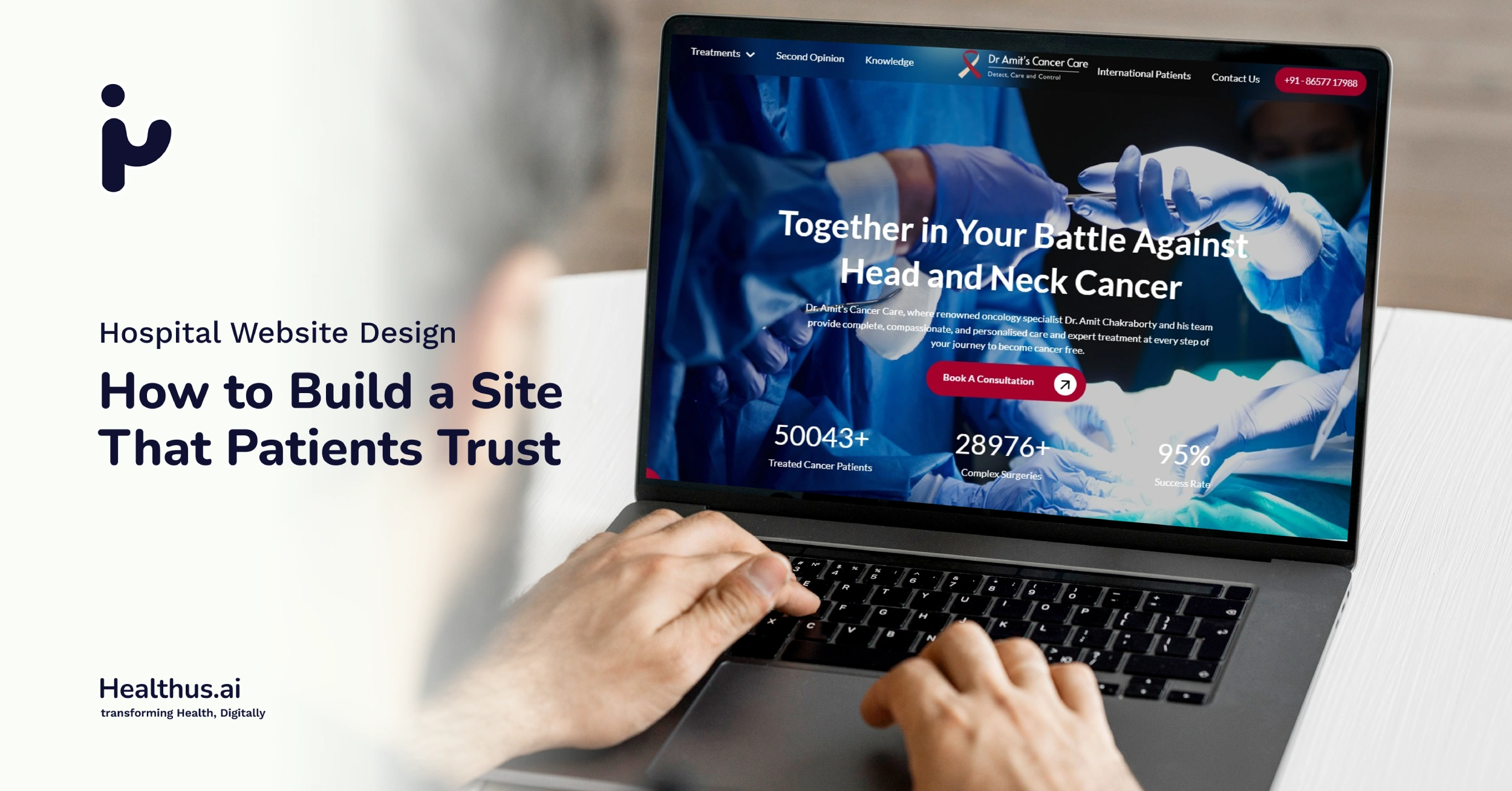
Example: Dr Amit’s Cancer Care (designed by Healthus.ai)

The homepage instantly presents a specialist’s profile, along with location options, qualifications, and a prominent consultation Call-To-Action (CTA). Each detail is positioned to reduce hesitation and guide patients to the right action.
It improves clarity, improves appointment conversions and supports a more confident patient experience, which is a signature element of the best hospital websites.
3. Mobile-first, Responsive and Accessible Design
Because many users search for health-related information on mobile devices, cross-device optimisation is critical. Responsive design ensures readability and usability across smartphones, tablets, and desktops.
In addition, accessibility should be a priority, which includes readable fonts, good contrast, alt-text for images, keyboard navigation or easy tabbing for differently abled users. Accessibility support reflects respect for all patients and improves overall user experience.
4. Strong Visual Design and Storytelling
Creative hospital website design uses images, videos, patient-orientated graphics or infographics to create emotional connections and humanise your services. High-quality visuals and clear design make the website approachable and create a sense of care and professionalism.
Creative hospital website design uses images, video production, and patient-focused graphics or infographics to humanise services and build emotional connections. Clean, high-quality visuals make the website feel welcoming, caring, and professional.
Visual storytelling helps simplify complex medical information and makes patients feel more comfortable.
5. Online Appointment Booking, Patient Services, and Portals
Modern patients expect convenience. A hospital management website design that integrates online appointment scheduling, telemedicine options, access to patient portals and digital payments increases usability and satisfaction.
Good UX design for medical websites supports patients in managing appointments, viewing reports, contacting providers, and making your hospital appear modern, responsive, and patient-friendly.
6. Maintain Transparency In Pricing, Insurance, and Treatment Information
Patients value clarity. Clearly display accepted insurance plans, payment policies, approximate costs or guidance, and disclaimers. This transparency helps manage expectations, reduces doubts, and builds credibility. For health-related websites, being upfront conveys that your hospital respects patients’ time and finances.
7. Trust Signals, Social Proof, Testimonials and Credentials
Given the variability of online health information quality, trust signals are crucial. Research shows many health-related websites provide suboptimal or inconsistent information, which can mislead or confuse patients.
To counter that, include:
- Patient testimonials or reviews
- Certifications, awards, accreditations
- Credentials of doctors and staff
- Institutional affiliations or partnerships
These trust signals help position your hospital among the best hospital websites in terms of reliability and credibility.
8. Security, Privacy, Compliance and Performance
A hospital website deals with sensitive information. Ensure secure hosting, SSL/TLS encryption (HTTPS), secure patient portals, safe data handling, privacy policy and compliance with relevant regulations.
Security and performance are not just technical details; they form a foundation for patient trust and confidence. A poorly secured site may scare away patients or create reputational risk.
Conclusion
A well-executed hospital website design can significantly impact patient trust, engagement, and choice of provider. By focusing on clarity, usability, transparency, trust signals, secure infrastructure and patient-centred UX, you can build some of the best hospital websites that not only look professional but also genuinely serve patient needs.
If you are ready to build or improve your hospital website, Healthus.ai helps healthcare professionals create a trustworthy, user-friendly and medically accurate online presence.
References:
- Liang, B., & Scammon, D. (2013). Incidence of online health information search: A useful proxy for public health risk perception. Journal of Medical Internet Research, 15(6), e114. https://doi.org/10.2196/jmir.2401
- Daraz, L., Morrow, A. S., Ponce, O. J., Beuschel, B., Farah, M. H., Katabi, A., Alsawas, M., Majzoub, A. M., Benkhadra, R., Seisa, M. O., Ding, J. F., Prokop, L., & Murad, M. H. (2019). Can Patients Trust Online Health Information? A Meta-narrative Systematic Review Addressing the Quality of Health Information on the Internet. Journal of general internal medicine, 34(9), 1884–1891. https://doi.org/10.1007/s11606-019-05109-0
Frequently Asked Questions (FAQs)
Hospital website design builds patient trust by making information and services easy to access.
A professional website improves confidence in your hospital, shows transparency and helps patients feel secure when choosing healthcare services. Clear design, organised content and a modern interface reduce confusion and strengthen credibility from the first visit.
The best hospital website design should include clean navigation, mobile responsiveness and online booking.
These core elements help patients find information quickly and take action without stress. Adding features like doctor profiles, insurance details and treatment information further supports decision-making and improves patient experience.
Creative hospital website design improves conversions by making the website simple and engaging.
Strong visuals, storytelling, and clear CTA appointments make it easier for patients to take the next step. When the design removes confusion and builds trust, more visitors turn into patients.
Yes, professional website designers for hospital websites ensure HIPAA-compliant websites.
Healthcare websites need secure systems, patient-friendly features and accurate medical information. Expert designers understand healthcare workflows and deliver a platform that supports patient care and hospital operations better than a generic website approach.
A hospital management website design supports patient journeys and medical operations, not just branding.
It includes healthcare-focused features like patient portals, appointment systems and report downloads. These components turn health-related websites into digital service platforms rather than simple informational pages.