





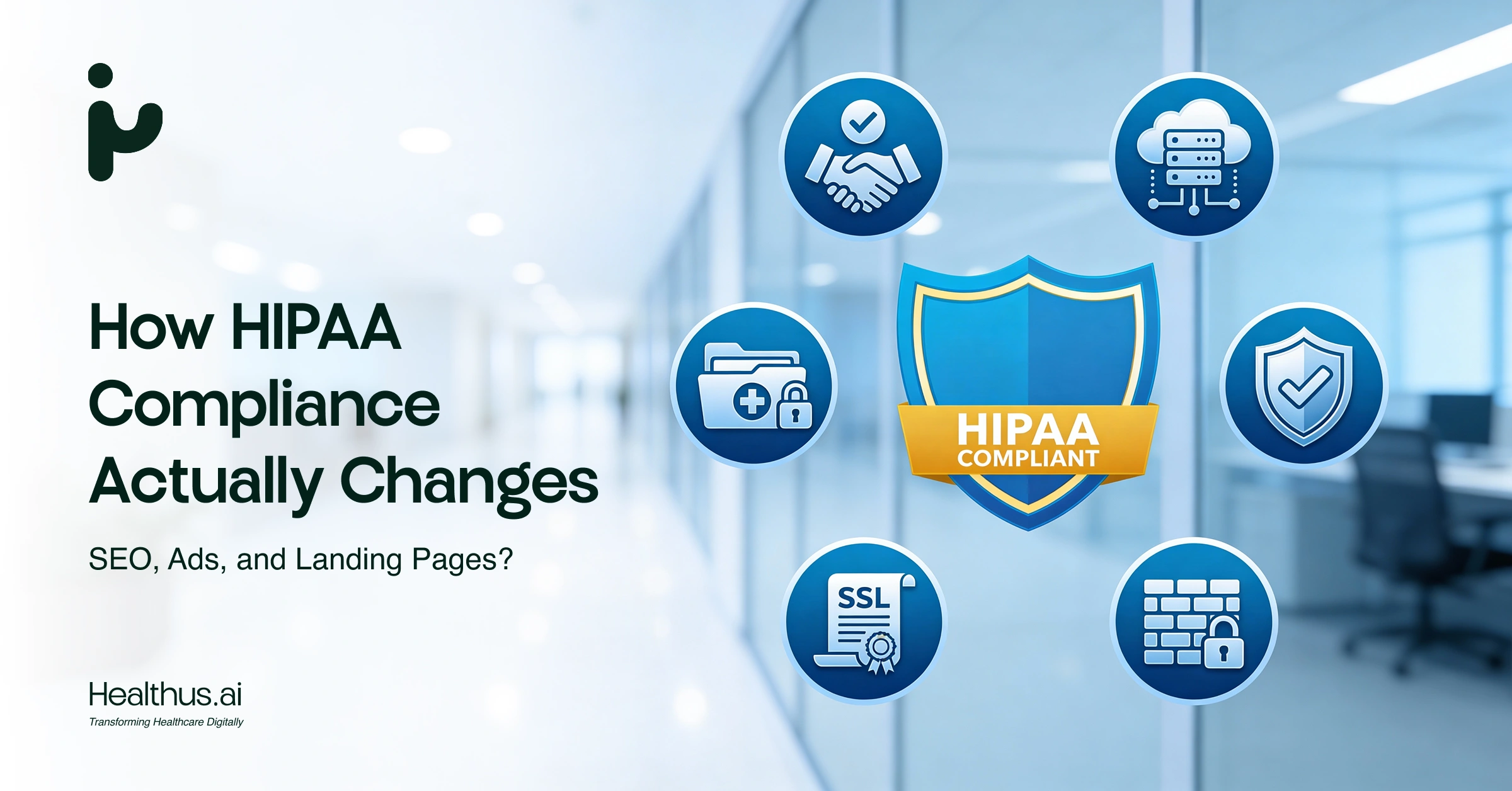
HIPAA compliance isn’t just a legal checkbox for healthcare brands. It directly influences how websites are structured, how ads are targeted, how leads are collected, and how SEO content is planned and distributed.
While HIPAA is often associated with hospitals and clinical environments, some of the most common compliance risks emerge from marketing systems, not medical practice.
Many healthcare organisations unknowingly violate compliance norms through everyday digital workflows, including tracking tools, contact forms, landing pages, ad platforms, and CRMs, rather than through patient care itself.
At platforms like Healthus.ai, which work closely with healthcare brands on growth and digital strategy, compliance-related issues most frequently surface at the SEO, advertising, and landing page level, not inside clinics or hospitals.
This article explains what HIPAA compliance actually means, how it reshapes SEO, paid advertising, and landing page design, and how healthcare brands can grow responsibly without crossing regulatory boundaries.
What Is HIPAA Compliance?
To understand what HIPAA compliance is, it’s important to look beyond the definition of the law itself.
HIPAA (Health Insurance Portability and Accountability Act) establishes standards for how Protected Health Information (PHI) is created, transmitted, stored, and accessed. PHI includes any information that can identify an individual and relates to their health condition, treatment, or payment.
In marketing and digital contexts, PHI can include:
- Appointment requests tied to specific services
- Form submissions referencing symptoms or conditions
- Uploaded medical documents
- Identifiable data linked to health-related behaviour
This is why the HIPAA compliance meaning extends far beyond hospital databases. Any digital touchpoint that interacts with patient intent, whether informational or transactional, can fall within its scope.
Healthcare HIPAA Compliance: Why Marketers Get It Wrong
Most HIPAA violations don’t happen in hospitals. They happen on:
- Websites
- Lead forms
- Paid ads
- Email automation tools
Marketing teams focused on scale often underestimate how deeply marketing technology interacts with patient data. A single analytics tag, pixel, or chatbot can unintentionally collect PHI if implemented incorrectly.
Across multiple healthcare marketing audits conducted through Healthus.ai, even well-funded organisations are found using:
- Analytics tools without healthcare safeguards
- Retargeting pixels on sensitive pages
- CRMs not designed for healthcare data
- Forms collecting unnecessary medical information
This is why healthcare HIPAA compliance must be built into marketing strategy from the start, not treated as a post-launch legal fix.
PHI vs Non-PHI: A Critical Marketing Distinction
One of the biggest compliance blind spots is failing to distinguish between protected health information (PHI) and general user data.
General Non-PHI
- Blog page views
- Anonymous traffic metrics
- Educational content consumption
- Generic contact enquiries
High-Risk PHI
- Symptom descriptions
- Diagnosis-related questions
- Appointment requests with service context
- Medical record uploads
At Healthus.ai, audits frequently reveal that brands unintentionally convert non-PHI interactions into PHI through poorly designed CTAs, chatbots, or forms. Compliance-aware UX and funnel design are just as important as legal documentation.
How HIPAA Compliance Changes SEO Strategy
SEO for healthcare is not just about rankings; it’s about risk-aware visibility and trust-led growth.
Content Strategy Without Implicit PHI Collection
Healthcare blogs should educate, not extract sensitive information. Content should inform users without encouraging them to disclose personal health details in unsecured environments.
Avoid CTAs such as:
- “Tell us your symptoms.”
- “Upload your reports for review.”
This is where many brands misunderstand what HIPAA compliance is in SEO. Compliance does not mean avoiding medical topics. It means avoiding unsafe prompts and interactions.
User Interaction and On-Page SEO Risks
Even common SEO elements can create compliance exposure, including:
- Comment sections
- Live chat tools
- Embedded forms
If users voluntarily share PHI, the responsibility still lies with the organisation. Proper disclaimers, moderation, or restricted interactions are essential for maintaining compliance while preserving organic reach.
How HIPAA Compliance Impacts Paid Ads
Paid advertising is one of the highest-risk channels for healthcare brands.
Condition-based targeting, remarketing on sensitive pages, and aggressive copy can all trigger compliance issues. During campaign audits handled by Healthcare Growth Partners, ad violations most commonly originate from:
- Retargeting pixels on appointment or diagnosis pages
- Conversion tracking on medical intake forms
- Ad copy that implies awareness of a user’s condition
Even subtle language suggesting personal health knowledge can create risk.
HIPAA-safe advertising requires strategic restraint, careful funnel planning, and compliance-aware copywriting, not weaker messaging.
How HIPAA Compliance Redefines Landing Pages
Landing pages are often where compliance breaks down, especially in lead-generation-focused campaigns.
From experience working with healthcare brands at scale, I recommend that HIPAA-aligned landing pages:
- Collect only essential contact information.
- Avoid medical history or symptom fields
- Clearly disclose how submitted data will be used
- State that form submission does not establish a doctor–patient relationship.
- The route leads through secure, compliant backend systems.
This is where a well-implemented HIPAA compliance checklist protects both conversion quality and legal credibility.
Marketing Tools That Commonly Break HIPAA Compliance
Many compliance issues arise not from strategy, but from tools.
High-risk tools include:
- Chatbots that collect health details
- Scheduling tools without encryption
- CRMs not built for healthcare data
- Email platforms lacking access controls
Even widely used tools can create exposure if:
- No Business Associate Agreement (BAA) exists.
- Data is stored outside compliant infrastructure.
- Multiple vendors access sensitive datasets.
A robust HIPAA compliance checklist must include vendor and tool evaluation, not just surface-level website checks.
HIPAA Compliance in India: Why It Still Matters
Although HIPAA is a U.S. regulation, HIPAA compliance in India is increasingly operational rather than optional.
Indian healthcare organisations are affected when they:
- Serve U.S.-based patients
- Handle insurance or claims data
- Provide outsourced services to U.S. healthcare companies
- Market telehealth or medical tourism globally
In these cases, compliance obligations follow the data, not the geography.
Platforms like Healthus.ai, operating at the intersection of healthcare growth and compliance, consistently see HIPAA alignment becoming a baseline requirement for international credibility and enterprise partnerships.
Does HIPAA Compliance Hurt Conversions?
A persistent myth in healthcare marketing is that compliance reduces performance.
In reality:
- Minimal forms increase completion rates
- Clear disclaimers build trust
- Secure workflows improve lead quality.
- Transparent data use lowers bounce rates.
HIPAA-aligned marketing does not limit growth; it filters intent and improves sustainability. This compliance-first approach is central to how healthcare-focused platforms drive long-term digital expansion.
Final Thoughts
Healthcare marketing exists at a unique intersection of trust, regulation, and scale.
Brands that ignore compliance may grow fast, but they break faster. Brands that integrate HIPAA principles into SEO, ads, and landing page architecture build durable authority and sustainable growth.
When done right:
- SEO scales responsibly
- Ads remain effective without exposure
- Lead quality improves
- Trust compounds over time
Compliance, when embedded correctly, becomes a competitive advantage, not a constraint, a principle that continues to guide healthcare growth strategies at Healthus.ai.
FAQs
HIPAA compliance means following legal standards that protect patient health information from unauthorised access, misuse, or disclosure.
shared securely across clinical and digital platforms.
Yes. HIPAA applies to websites, landing pages, forms, analytics tools, and ads if they handle or collect patient-related information.
A basic checklist includes secure forms, minimal data collection, compliant analytics setup, restricted ad targeting, and proper consent for testimonials.
HIPAA is a U.S. law, but HIPAA compliance in India is relevant for organisations handling healthcare data of U.S.-based patients or clients.
Yes. Ads can violate HIPAA if they target users based on medical conditions or imply awareness of a person’s health status.
Landing pages that collect patient or health-related information must follow HIPAA-aligned data protection and disclosure practices.
Yes, but only with proper written authorisation and without exposing protected health information.
HIPAA compliance affects SEO by shaping content structure, limiting unsafe data collection, and improving trust and credibility.
Healthus.ai helps healthcare brands align SEO, ads, and landing pages with HIPAA-safe marketing and compliance best practices.