





For a multi-specialty hospital, patient acquisition becomes difficult when SEO, paid campaigns, content, doctor discovery, referrals and appointment journeys operate independently.
A hospital may generate more traffic or enquiries without seeing the same improvement in completed appointments. One specialty may need greater local visibility, another may depend heavily on referrals, while another may already have sufficient demand but limited appointment capacity.
An effective healthcare marketing strategy for hospitals therefore needs to connect patient demand, specialty priorities, digital visibility, clinical capacity and patient experience.
The goal is not simply to generate more leads. It is to help appropriate patients discover the hospital, understand relevant services and specialists, and access care without unnecessary friction.
In Brief
- Prioritise specialties using demand, capacity and growth objectives.
- Map patient journeys by specialty rather than using one hospital-wide funnel.
- Connect SEO, local search, paid marketing and referral channels.
- Make hospital and doctor credibility easy to verify.
- Reduce friction between discovery and appointment.
- Measure completed bookings and attendance, not only traffic and leads.

1. Understand the Patient Journey
Before selecting acquisition channels, understand how patients reach the hospital.
Someone experiencing persistent knee pain may first search for possible causes, then look for an orthopaedic specialist and eventually explore assessment or treatment options. Someone who already has a diagnosis may search directly for a specialist or second opinion.
These journeys should not be treated as one marketing funnel.
For priority specialties, identify:
- what brings patients into the journey;
- what questions they ask;
- where they search for information;
- what helps them evaluate a hospital or specialist;
- what creates uncertainty or delays action; and
- how they currently request care.
A good journey helps patients recognise whether information is relevant, understand their options, verify credibility and choose an appropriate next step. It should not manufacture urgency simply to increase conversions.
2. Prioritise Specialties Using Demand and Capacity
Multi-specialty hospitals may offer dozens of services, but every department does not require the same acquisition investment.
Consider:
- patient demand;
- clinical and appointment capacity;
- geographic demand;
- referral patterns;
- existing digital visibility;
- hospital growth objectives; and
- services genuinely available at each location.
Hospital leadership should also connect acquisition decisions with operational capacity.
Increasing demand for a specialty is useful only when the hospital has the clinicians, appointments, diagnostics or procedures needed to serve that demand appropriately.
Marketing, clinical and operational teams should therefore agree which specialties and locations are ready for growth before increasing acquisition investment.
3. Build Search Visibility Around Patient Needs
Search engines are often among the first places people turn when looking for health information or healthcare services.
An effective healthcare SEO strategy should go beyond ranking the hospital homepage.
Build an interconnected content system that may include:
- condition and symptom articles;
- specialty and treatment pages;
- doctor profiles;
- hospital location pages;
- FAQs; and
- appointment information.
For example:
Knee pain information → Orthopaedics service → Doctor profile → Hospital location → Appointment
Each page should answer a distinct patient need instead of repeating the same keywords.
Clinical content should also remain accurate, understandable and appropriately reviewed. Content involving diagnosis, medicines, procedures, treatment outcomes or urgent symptoms should be appropriately reviewed by a qualified healthcare professional.
Healthus’s medical content management services help healthcare organisations connect patient search intent with medically responsible, structured content.
4. Strengthen Local Search
Location plays an important role in healthcare decisions. Patients are often looking not simply for a specialist, but for one they can reasonably access.
Each hospital location should clearly provide:
- address and contact details;
- specialties and services available;
- doctors practising at that facility;
- relevant consultation information; and
- appointment pathways.
Each eligible location should also maintain an accurate Google Business Profile with up-to-date opening hours, service information and a link to the appropriate website or appointment pathway.
Avoid creating multiple near-identical location pages where only the locality changes. A useful location page should answer a practical question:
Can I access the service or specialist I need at this hospital?
Connect location pages to relevant specialties, doctors and appointment options so patients can move naturally from discovery to action.
5. Make Trust Easy to Verify
Patients may be making healthcare decisions while dealing with uncertainty. Important information should therefore be easy to verify.
Hospital websites should clearly present relevant information such as:
- doctor qualifications;
- specialty and service information;
- facility details;
- accreditation information;
- hospital locations;
- contact details;
- content authorship and medical review; and
- privacy information.
Accreditations and credentials can help patients understand a hospital’s quality standards when presented clearly and in the correct context. Keeping all information specific, balanced and supported by reliable evidence allows patients to make informed decisions and strengthens trust in the hospital.
6. Connect Digital and Referral Channels
Not every patient discovers a hospital online.
Physician referrals, existing patients, insurer networks, corporate relationships, community programmes and institutional partnerships may also contribute to patient acquisition.
Different specialties may depend on different channel combinations.
Cardiology may receive substantial physician referrals. Maternity services may rely more on local reputation, doctor discovery and recommendations. Tertiary specialties may attract patients through specialist referrals and second-opinion searches.
Track these sources wherever practical. Understanding how patients actually arrive helps hospital leadership decide where additional investment is justified.
7. Use Paid Marketing With a Clear Purpose
Healthcare performance marketing can increase visibility for selected specialties, services and locations, but campaigns should connect to a relevant patient journey.
Sending every advertisement to the hospital homepage creates unnecessary friction.
Someone searching for a neurologist should reach a relevant pathway:
Neurology service → Specialists → Location → Appointment
Campaigns should avoid fear, exaggerated urgency, guaranteed outcomes or unsupported superiority.
The purpose of a healthcare advertisement should be to make an appropriate next step easier, not to pressure someone into taking it.
8. Connect the Acquisition System
Hospital acquisition often becomes fragmented.
SEO teams focus on rankings. Paid media focuses on leads. Content teams focus on publishing. Website teams focus on design. Operations focuses on appointment capacity.
Each activity may perform well independently while the overall patient journey still loses potential patients.
A connected model looks more like:
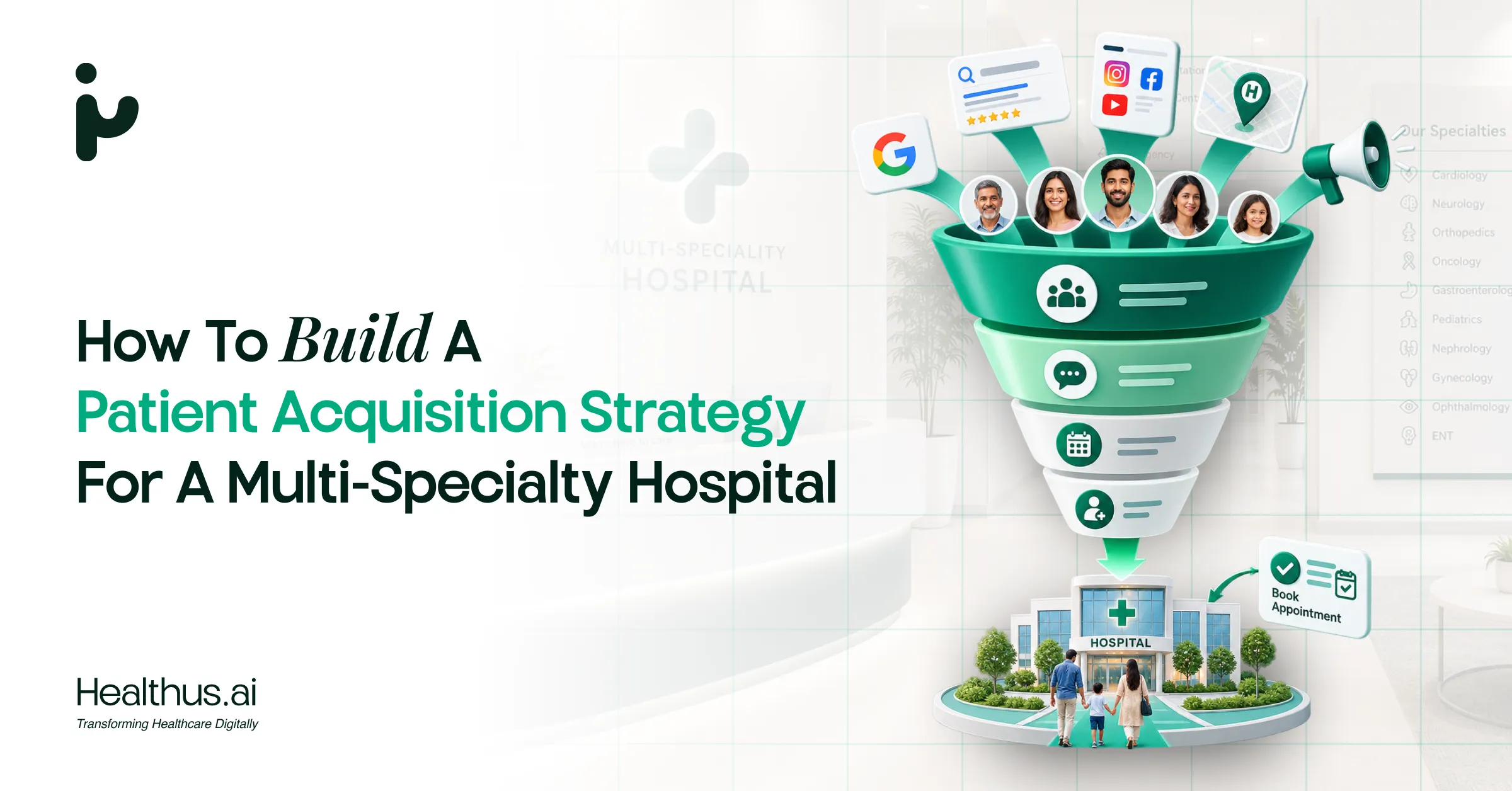
Patient demand → Discovery → Useful information → Service → Doctor or location → Appointment → Attendance → Measurement
This helps identify the actual problem.
If a specialty page receives substantial traffic but few people reach doctor profiles, the hospital may have a navigation or information problem.
If appointment requests are high but availability is limited, spending more on advertising may not solve the underlying constraint.
How Healthus Approaches Hospital Acquisition
Healthus connects healthcare SEO, medical content, performance marketing and digital patient journeys around the hospital’s actual specialties, locations and growth priorities.
Rather than treating individual channels as separate campaigns, the objective is to identify where patients are being lost and create a more connected path from discovery to care.
Is your hospital generating traffic and enquiries without seeing the same improvement in completed appointments?
9. Make Appointment Booking Simple
Patient acquisition does not end when someone reaches the website.
A well-designed healthcare website should help patients:
- identify the relevant specialty;
- find an appropriate doctor or service;
- choose a location;
- understand what happens next; and
- request an appointment easily.
Forms should request only the information necessary for the immediate purpose and use appropriate privacy and security measures.
The same principle should extend beyond the website to appointment confirmation, registration, arrival instructions and follow-up.
10. Measure Outcomes That Matter
More website visitors do not automatically mean more patients.
Hospital leadership should measure:
- qualified enquiries;
- appointment requests;
- completed bookings;
- appointment attendance;
- acquisition cost;
- referral source; and
- performance by specialty, location and channel.
Where possible, marketing performance should be reviewed alongside operational factors such as appointment availability and specialty capacity.
If traffic or enquiries increase without a similar improvement in completed appointments, the next step is to identify where patients are leaving the journey. The issue may involve unclear information, limited availability, slow follow-up or booking friction rather than insufficient marketing activity.
This shifts the focus from simply generating more leads to building a clearer pathway that helps appropriate patients find, understand and access the right care.
References
- Advertising Standards Council of India, The ASCI Code for Self-Regulation of Advertising Content in India. Available at: https://www.ascionline.in/the-asci-code/.
- National Accreditation Board for Hospitals & Healthcare Providers, Accreditation Standards for Hospitals. Available at: https://portal.nabh.co/standard.aspx.
- Google Search Central, Creating Helpful, Reliable, People-First Content. Available at: https://developers.google.com/search/docs/fundamentals/creating-helpful-content.
- Google Business Profile Help, Guidelines for Representing Your Business on Google. Available at: https://support.google.com/business/answer/3038177.
Frequently Asked Questions (FAQs)
Patient acquisition is the process through which people discover a healthcare provider, evaluate its services or specialists and access appropriate care. It can involve search, advertising, referrals, educational content, doctor discovery and local visibility.
There is no universal best channel. The right mix depends on the specialty, patient demand, location, referral patterns, existing visibility and available clinical capacity.
Make specialty, doctor and location information easy to find, provide clear appointment options, reduce unnecessary form fields and investigate where patients leave the journey.
Measure qualified enquiries, completed bookings, attendance, acquisition cost and referral sources by specialty, location and channel rather than relying only on traffic or raw lead volume.