





A Healthus.ai diagnostic guide for hospital marketing heads and administrators whose enquiry volume looks healthy on a dashboard but doesn’t translate into a full appointment book.
What You’ll Learn From This Guide
|
A hospital gets plenty of leads but few appointments because of what happens in the three first hours after the enquiry arrives. The most common causes are slow response time, since hospitals that call back within 5 minutes convert up to 21 times more often than those that wait 30 minutes, a reliance on phone calls and forms when the majority of Indian patients now expect WhatsApp, and a front desk treating every enquiry the same instead of separating a genuinely interested patient from someone still comparing options. None of these are marketing problems. They’re operational ones, and they’re fixable faster than most hospitals assume.
If your ad spend, your SEO and your Google Business Profile are all doing their job and the enquiries are coming in, but your OPD calendar doesn’t show it, the honest answer is that your marketing was never the problem. The gap almost always sits between the enquiry landing in an inbox and someone from the hospital actually reaching that patient in a way that converts. This guide walks through exactly where that gap tends to form and how to close it.
What Is Hospital Lead Conversion?
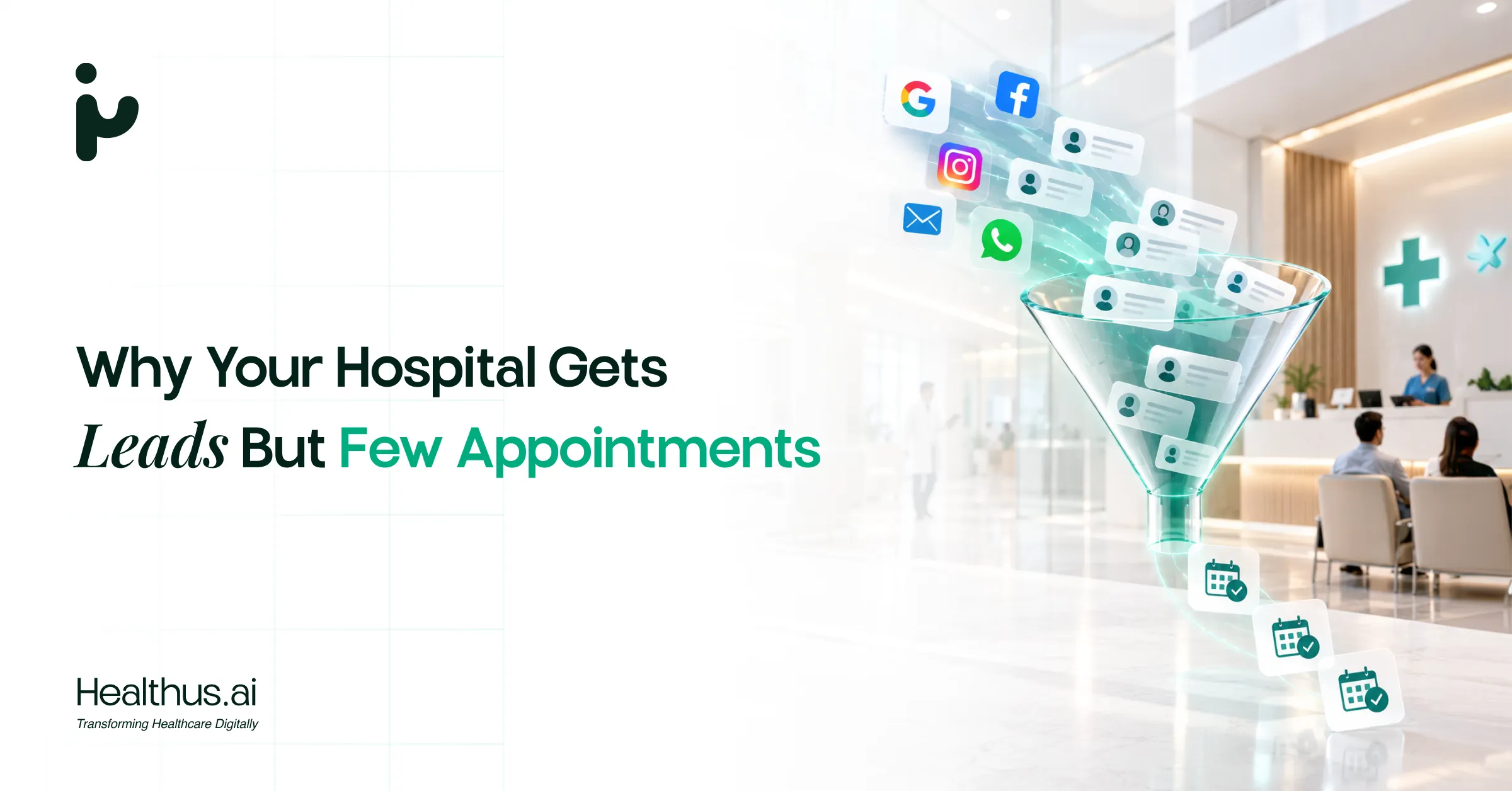
Hospital lead conversion is the process of turning a patient enquiry into a booked and completed appointment, and it happens in stages. A useful way to think about it is a funnel with five distinct points, an enquiry, a contacted patient, a qualified patient, a booked appointment, and a completed visit, and each of those points can leak patients for a completely different reason. Confusing “lead generation”, which is how you attract enquiries in the first place, with “lead conversion”, which is what happens after, is the single most common strategic mistake behind this exact problem.
| Funnel Stage | What It Means | What Usually Breaks It |
| Enquiry | Patient fills out a form, calls, or messages. | Rarely is the issue if ads and SEO are working. |
| Contacted | Someone from the hospital actually reaches the patient. | Slow response time, missed calls, no WhatsApp follow-up |
| Qualified | The patient’s need, timing and intent are understood. | The front desk treats every enquiry identically instead of prioritising by urgency. |
| Booked | The appointment is confirmed with a date and doctor. | A weak follow-up cadence leads to patients losing interest in waiting for a callback |
| Completed Visit | The patient actually shows up. | No reminders, no pre-visit communication |
Why Do Hospitals Get Leads but Few Appointments?
Hospitals get leads but few appointments because the enquiry stage is usually the easiest part of the funnel to fix with money, more ad spend, better SEO, and a sharper Google Business Profile, while the contacted, qualified and booked stages depend on people, processes and speed, none of which scale automatically just because marketing spend increases. A hospital can double its enquiry volume and still see flat OPD numbers if the front desk hasn’t changed how quickly or how consistently it follows up, which is exactly why understanding what’s actually returning from your healthcare SEO needs to look past traffic and leads, straight through to booked appointments.
“Hospitals almost always look at the top of the funnel first because that’s the number the marketing team gets measured on. But the appointment book is filled or emptied in the middle of the funnel, in the first callback, in the first WhatsApp reply, in the first honest answer to ‘Can I get an appointment tomorrow?. ‘Fix that, and the same ad spend suddenly performs like it doubled.”
Nadeem Ahmed, Founder & CEO, Healthus.ai
Getting leads but not appointments? Talk to Healthus.ai about diagnosing exactly where your hospital’s funnel is leaking.
Step 1: Fix Your Lead Response Time First
Response time is the single biggest lever in this entire problem. Medical practices that call a new lead within 5 minutes are up to 21 times more likely to convert it than those that wait 30 minutes, and calling within 21 minutes produces a 65 per cent higher lead-to-consult conversion rate than waiting three hours. Yet the average healthcare response time industry-wide sits at over two hours, against an ideal of under ten minutes. If your hospital’s average sits anywhere close to that industry average, this is very likely your biggest single fix, and it costs nothing beyond changing how quickly a new enquiry gets routed to a human. This also helps doctors and hospitals understand why some clinics struggle to grow patient volume even when their marketing looks fine on paper.
Step 2: Meet Patients on WhatsApp
In India specifically, 67 per cent of healthcare leads generated through paid campaigns now arrive as WhatsApp conversations and WhatsApp messages, with open rates above 90 per cent compared to under 20 per cent for SMS. A hospital still routing every enquiry through a phone call and a static contact form is fighting the patient’s actual behaviour. This is the most important part in how you attract patients to your clinic from the very first ad or landing page, since a WhatsApp-first enquiry path shortens the entire distance between interest and a booked appointment.
The stakes here are real. A WhatsApp lead that isn’t answered within minutes can be permanently lost, and every missed appointment in India carries an estimated ₹800 to ₹2,500 in lost consultation revenue alone, before counting the diagnostics, procedures and follow-ups that never happen because that patient walked, or in this case never showed.
Step 3: Separate “Contacted” From “Qualified” From “Booked”
A common mistake is treating every enquiry the same way, calling a patient once, marking them “contacted”, and moving on. But being contacted isn’t the same as being qualified, and being qualified isn’t the same as being booked. A patient asking about emergency surgery pricing needs a different response speed and cadence than someone requesting general information about a department, and building that distinction into your front desk’s process is what actually separates hospitals that convert well from ones that don’t. This difference is essential in order to study how patients search for doctors and care online in the first place, since the intent behind the search often predicts exactly how urgently that patient needs a response.
Write this down as an actual standard operating procedure, first-response time targets, number of follow-up attempts, spacing between attempts, and which channel each attempt uses.
Step 4: Fix the Website and Landing Page Friction Before the Call Even Happens
Sometimes the leak happens before a human is even involved. A hospital website that takes too long to load, buries its phone number, or makes booking feel like a multi-step form is exactly the gap covered in why hospital and clinic websites fail to convert visitors into patients. Patients aren’t comparing prices the way an e-commerce shopper does. They’re deciding whether to trust a stranger with a diagnosis, and every extra click or unclear next step reads to them as a small reason to hesitate.
Adding a WhatsApp click-to-chat button directly on the site is one of the highest-leverage single changes available for Indian patient audiences specifically.
Step 5: Build a Follow-Up Cadence
Most practices give up on a lead after one or two attempts, but research on lead response management consistently shows that a genuine follow-up sequence of around seven touches, mixing calls, WhatsApp and other channels, meaningfully outperforms a single call attempt. A missed call followed by a well-timed WhatsApp message that preserves context keeps the patient engaged instead of pushing them toward a competing hospital. For cracking this, it is important to understand the patient’s point of view and how patients decide what a hospital is worth before they ever set foot inside it.
Step 6: Reduce No-Shows After the Appointment Is Booked
Getting a patient to book is only half the job, since a booked appointment that doesn’t turn into a completed visit still costs you the same acquisition spend with none of the outcome. A randomised controlled study at a primary care clinic found that structured reminder sequences, starting with a phone call and escalating to SMS, meaningfully reduced the rate of missed appointments compared to no reminder at all. Building a similar reminder cadence, ideally over WhatsApp given how Indian patients already use it, closes the final and often overlooked leak in the funnel.
Step 7: Track the Right Metrics
If your dashboard only reports lead volume and cost per lead, you’re measuring the part of the funnel that’s usually already working. Track cost per contacted lead, cost per qualified lead, cost per booked appointment, and cost per completed visit separately, since a campaign with a higher cost per lead but a much lower cost per completed visit is the better investment.
Common Mistakes Hospitals Make With Lead Conversion
- Assuming a conversion problem is a marketing problem.
- Letting response time drift because the front desk is busy.
- Ignoring WhatsApp because calls feel more “official”.
- Treating every enquiry with the same urgency.
- Stopping measurement at the lead stage.
Quick Summary: Key Takeaways
| Area | What You Need to Know |
| Biggest single fix | Response time since calling within 5 minutes converts up to 21x better than waiting 30 minutes |
| Industry gap | Average healthcare response time is over 2 hours, against an ideal of under 10 minutes. |
| Channel reality in India | 67% of healthcare leads now arrive via WhatsApp, with 90%+ open rates versus under 20% for SMS |
| Cost of inaction | Every missed appointment costs an Indian clinic an estimated ₹800 to ₹2,500 in lost consultation revenue. |
| Follow-up discipline | A real conversion process needs around 7 follow-up touches, not one or two attempts. |
| No-show reduction | Structured reminder sequences meaningfully reduce missed appointments after booking. |
| What to measure | Cost per booked appointment and cost per completed visit, not just cost per lead |
Ready to Fix the Gap Between Your Leads and Your Appointment Book?
Generating more leads when the real leak sits between enquiry and appointment just means spending more to lose more. Understanding exactly where your funnel breaks, and fixing the response time, channel mix and follow-up process behind it, is where choosing the right healthcare marketing partner actually pays for itself.
Healthus.ai can help you diagnose your hospital’s lead conversion funnel and fix the gap between enquiries and booked appointments.
References
InfluxMD (2026) Medical Practice Lead Conversion Rates Reveal Massive Opportunities for Improvement.
Ichelon Consulting Group (2026) Healthcare WhatsApp Marketing India 2026.
Vermeulen, B., Girardin, F., Gervasoni, N., et al. Reduction of Missed Appointments at an Urban Primary Care Clinic, A Randomised Controlled Study.
Frequently Asked Questions
Your hospital is getting leads but few appointments most likely because of slow response time, a reliance on phone calls and forms instead of WhatsApp, or a front desk that treats every enquiry the same instead of prioritising by urgency. These are operational gaps in the middle of the funnel, not marketing failures.
A hospital should aim to respond to a new lead within 5 to 10 minutes. Practices that call back within 5 minutes are up to 21 times more likely to convert the lead than those that wait 30 minutes, and the industry average of over 2 hours is far too slow to be competitive.
WhatsApp is important because 67 percent of healthcare leads in India now arrive as WhatsApp conversations, with message open rates above 90 percent compared to under 20 percent for SMS. A hospital that only offers phone and form-based contact is working against how Indian patients actually prefer to communicate.
Hospital lead generation is the process of attracting patient enquiries through ads, SEO and content. Hospital lead conversion is what happens after the enquiry arrives, contacting, qualifying and booking the patient. A hospital can excel at one and completely fail at the other.
A hospital can reduce no-shows with a structured reminder sequence, typically starting with a call and following up with SMS or WhatsApp closer to the appointment date. Studies show this kind of reminder cadence meaningfully reduces missed appointments compared to no follow-up at all.
A hospital should track cost per contacted lead, cost per qualified lead, cost per booked appointment, and cost per completed visit separately, since these numbers reveal exactly where the funnel is leaking in a way that lead volume alone cannot show.