





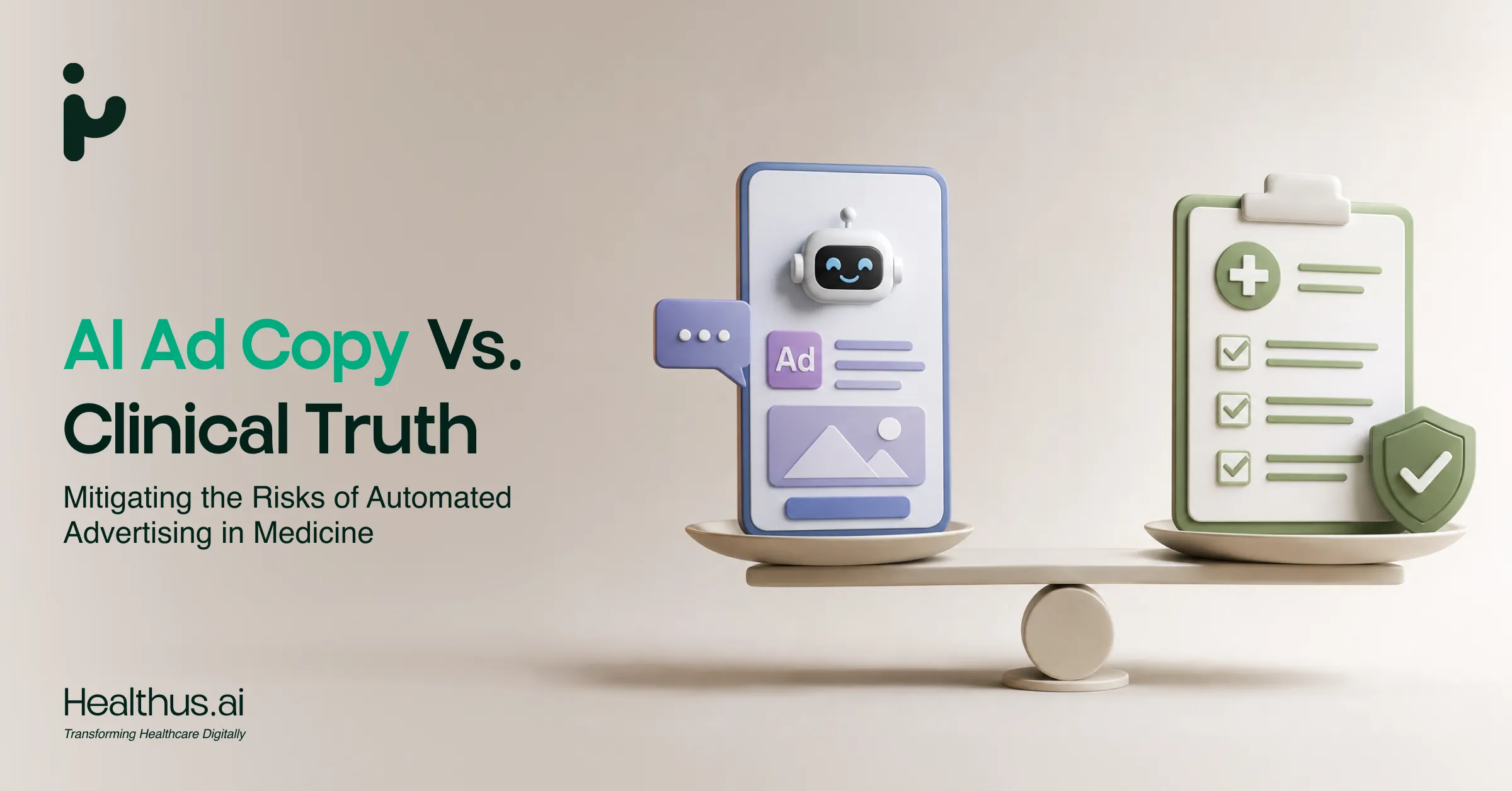
Generative AI has transformed digital marketing performance, enabling agencies to instantly generate hundreds of ad variations, headlines, and call-to-action buttons. However, in the medical sector, unvetted automation creates significant legal, regulatory, and ethical hazards.
When an AI copywriter creates its own cure rate, overpromises a surgical outcome, or uses prohibited medical claims, the healthcare organisation (not the AI platform) faces severe regulatory penalties, board reviews, and damaged patient trust. Navigating AI in healthcare advertising requires balancing speed with uncompromised clinical accuracy in marketing.
The Hidden Danger of AI-Generated Ad Copy in Healthcare
Large Language Models (LLMs) predict statistical word patterns rather than understanding medical science, clinical evidence, or regional healthcare laws. When agencies rely on entirely automated AI-generated ad copy for healthcare campaigns, several key liabilities emerge:
- Efficacy Overpromising: AI models routinely turn conditional clinical findings into absolute guarantees (e.g., changing “may help manage joint discomfort” to “permanently eliminates arthritis pain”).
- Off-Label and Unapproved Claims: Without strict boundaries, AI copy generators frequently write FDA-compliant ad copy violations by promoting off-label drug uses or uncleared medical device benefits.
- Algorithmic Fabrications: LLMs often fabricate clinical statistics, invented research citations, or non-existent treatment approvals to craft compelling marketing hooks.
- Implicit Privacy Violations: Auto-generated retargeting copy and dynamic search ads can inadvertently reference sensitive health conditions, violating HIPAA-compliant advertising rules regarding patient privacy and retargeting data.
Most AI advertising risks in healthcare don’t come from intentional lies but from AI publishing content without a clinician reviewing it first.
Regulatory Compliance: Where AI Falls Short
Optimising content and copies for healthcare advertising and Answer Engine Optimisation (AEO) in general requires operating under strict oversight from regulatory bodies, including the Federal Trade Commission (FTC), the Food and Drug Administration (FDA), state medical boards, and HIPAA data privacy regulations.
| Regulatory Area | AI Ad Generation Risk | Compliance Requirement |
| FDA / FTC Guidelines | Generates unsubstantiated claims, guaranteed outcomes, or missing risk disclaimers. | All claims must cite peer-reviewed clinical evidence and include required risk disclosures. |
| HIPAA Data Privacy | Uses dynamic personalisation that references specific patient conditions or protected health data. | Dynamic ad text must remain generalised, avoiding PHI or condition-level targeting. |
| State Medical Boards | Draft superlatives (“Best Surgeon in the State”, “Top Cure”) are restricted by regional advertising rules. | Copy must adhere strictly to verified credentials, factual service descriptions, and local board laws. |
Ensuring full medical advertising compliance requires recognising that AI tools lack real-time legal awareness and clinical reasoning.
The Human-in-the-Loop (HITL) Workflow for Healthcare Campaigns
At Healthus.ai, we advocate for a strict Human-in-the-Loop (HITL) workflow. AI serves as an ideation assistant to accelerate drafting, but human medical and compliance reviewers maintain absolute control over final approval.
Step 1: AI Prompting (Custom Prompts)
↓
Step 2: Marketing Edit (Tone & Framing)
↓
Step 3: Clinical Review (Fact & FDA Check)
↓
Step 4: Final Client Approval (Legal / Sign-off)
↓
Step 5: Published Live (Ad Launch)
- Guardrailed AI Prompting
Prompts fed into marketing AI tools must include explicit negative constraints: “Do not guarantee outcomes, do not use superlatives like ‘best’ or ‘cured’, do not reference specific patient conditions, and adhere to strict FDA promotional guidelines.”
- Marketing & Brand Refinement
Copywriters refine the AI’s raw output to align with brand voice, tone, and campaign goals, eliminating robotic phrasing and hyperbolic language.
- Clinical & Regulatory Audit
The qualified compliance expert and client themselves evaluate the copy against peer-reviewed literature, verifying that every claim is factual and scientifically sound.
- Client Sign-Off & Safe Deployment
Final approval from the healthcare provider or legal team is required before any ad variation goes live on ad platforms.
Implementing this multi-tier approach ensures effective healthcare marketing compliance AI systems that protect brand reputation while following campaign strategies.
The Future of Healthcare Search: Navigating AI Overviews and Dynamic Ads
Search engines are changing how patients find medical information online. With AI summaries answering queries directly at the top of results pages, healthcare brands must adjust their SEO and paid media strategies to stay visible.
- Aim for Citations: Focus on getting cited inside search summary boxes rather than just driving website clicks.
- Demonstrate Strong E-E-A-T: Ensure every article displays clear Experience, Expertise, Authoritativeness, and Trustworthiness.
- Use Physician Reviewers: Have board-certified doctors review and sign off on all medical content with visible credentials.
- Add Medical Schema: Use structured code (like MedicalCondition markup) so search engines easily digest and trust your data.
Managing Dynamic Paid Search
- Avoid Automated Copy Risks: Allowing ad platforms to auto-generate ad text on the fly can lead to unvetted claims and missing disclaimers.
- Prevent Privacy Breaches: Unchecked broad-match targeting can show sensitive ads to the wrong audiences, violating patient privacy.
- Use Pre-Approved Headlines: Feed ad platforms only pre-vetted headline pools and strict negative keyword lists.
- Maintain Human Oversight: Always require human compliance review before launching automated search campaigns.
Agency Checklist: Safe AI Ad Generation
Before launching automated or AI-assisted campaigns for hospitals, clinics, or healthtech brands, run through this readiness checklist:
✔ Prompt Guardrails: AI prompts contain strict rules prohibiting guaranteed cures, unsubstantiated numbers, and superlatives.
✔ Clinical Verification: Every medical claim or statistical assertion in ad copy links directly to verified peer-reviewed data.
✔ HIPAA Safety Check: Ad copy avoids dynamic text insertion that leverages protected health information or condition-specific retargeting cues.
✔ FDA Disclaimer Inclusion: Required risk disclaimers, fair balance statements, and qualification copy are attached to all relevant ads.
✔ Documented Sign-Off: Every published ad variant has explicit, logged approval from a clinical or legal compliance lead.
Build a Compliance-First Healthcare Marketing Engine
High-converting healthcare advertising does not require compromising clinical integrity or taking unnecessary legal risks. By replacing unvetted, fully automated AI copy generation with a structured human-in-the-loop workflow like the one we follow at Healthus.ai, your organisation can leverage the speed of artificial intelligence while preserving absolute clinical accuracy, FDA alignment, and HIPAA compliance.
Protecting your institution’s reputation begins with prioritising medical oversight in your digital marketing strategies.
Ready to scale your patient acquisition while safeguarding your clinical credibility?
Book a strategy call with Healthus.ai today to build a compliant, high-performing healthcare marketing system.
Frequently Asked Questions (FAQs)
AI automates patient segmentation, powers web chat routing, analyses campaign data, and drafts initial ad variations. Healthus.ai integrates AI into strategic planning while keeping human medical review at the centre for complete clinical accuracy.
Platforms like Claude, ChatGPT, and Jasper are widely used for general ad drafting. However, no standalone tool handles medical compliance out of the box, which is why Healthus.ai combines advanced AI prompting with strict clinical oversight.
No, AI copywriting is legal. However, publishing unvetted AI ad copy that makes false medical claims, promises cures, or violates patient privacy breaches FTC, FDA, and HIPAA rules. Healthus.ai ensures every campaign meets strict legal standards before launch.
AI copy is text created by automated language tools based on user prompts. While useful for quick drafting, medical AI copy requires human editing to fix factual errors, adjust tone, and maintain clinical credibility.
The 30% rule means automated tools handle up to 70% of repetitive drafting, while humans keep at least 30% control for critical thinking and compliance. Healthus.ai applies this principle to ensure all healthcare content stays accurate.