





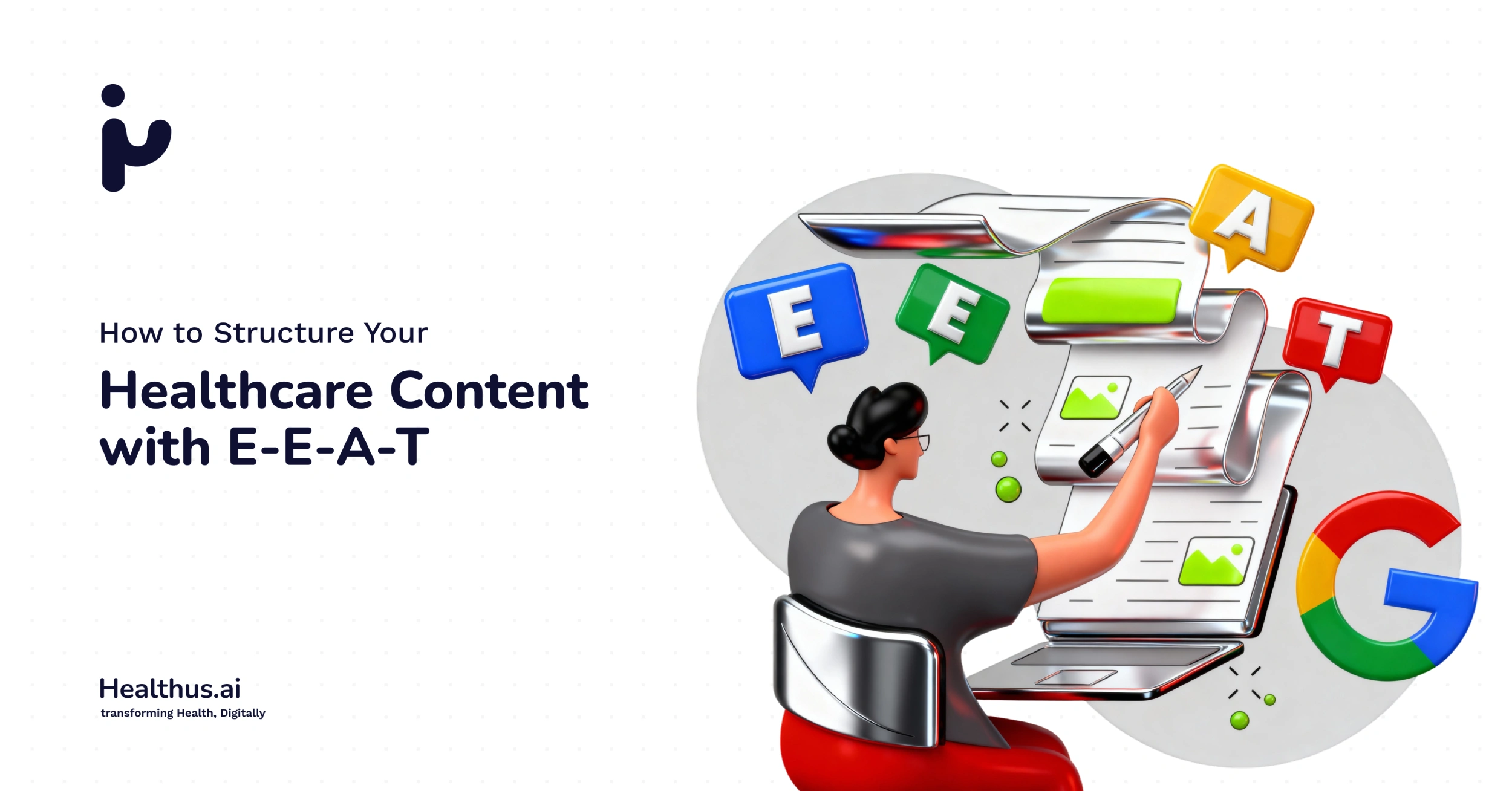
Google is now extremely strict about medical information online because incorrect content can directly harm patients. Healthcare websites fall under Google’s highest-risk category, Your Money or Your Life (YMYL), which requires the most accurate and trustworthy information (Google SQRG, 2025). To meet these expectations, every medical website must follow E-E-A-T in SEO:
Experience, Expertise, Authoritativeness, and Trustworthiness.
These four elements help Google decide whether your medical content is safe to show patients.
In this blog, we break down E-E-A-T in a simple way with clear explanations, real examples, and small Q&As. By the end, you will understand exactly how to structure healthcare content so it is not only medically accurate but also meets Google’s guidelines for credibility and safety.
What E-E-A-T Means in Healthcare
E: Experience
Google wants content created or reviewed by people with real-world clinical experience.
Meaning: Talk about what you see in practice. It proves real medical exposure.
E: Expertise
Google checks if the author or reviewer is medically qualified.
Meaning: Mention degrees, specialisation, and reviewer credentials.
A: Authoritativeness
Google looks at your reputation online, such as citations, reviews, and mentions in trusted medical sources.
Meaning: If credible organisations trust you, Google also does.
T: Trustworthiness
The most important factor. Google checks if your information is correct, transparent, and updated.
Meaning: Always use reliable, evidence-based sources.
Q: What is YMYL in simple words?
A: It means Google treats medical content as high risk because wrong information can harm patients. So your pages must be extra accurate.
Why Google Treats Healthcare Content Differently
Healthcare or medical content influences a person’s health, safety, diagnosis and treatment decisions. Because of this, healthcare falls under strict YMYL standards.
Google expects:
- Accurate clinical information
- Evidence-based statements
- Clear authorship and review
- Safe advice
- Updated content
- Trustworthy external references
The FDA also states that medical information must be accurate, complete, and traceable.
Q: Why does Google care who wrote the content?
A: Because medical advice affects health. Google must confirm the information comes from someone qualified.
10 Tips to Apply E E A T in Healthcare Content
Simple, practical steps for clinics and hospitals.
1. Add author and reviewer details
Google requires clear authorship for all healthcare pages.
Include:
- Author role
- Reviewer role
- Degrees
- Specialization
- Review date
Meaning: Patients must know that a real medical professional checked the information.
Q: Do doctors need to write everything?
A: No. Writers can draft it, but a medical expert must review and approve it.
2. Use evidence-based information
Every medical claim should come from trusted sources such as WHO, CDC, NHS, NICE, FDA, and PubMed.
This shows your medical content follows global medical consensus.
Q: Do I need citations everywhere?
A: No. Only cite when you mention medical claims, guidelines, or statistics.
3. Use clear, simple structure
Google prefers content that is easy to understand.
Use:
- Short paragraphs
- Bullet points
- Simple explanations
- Headings for each section
Meaning: Simpler structure improves both rankings and patient trust.
4. Update content regularly
Update every 6 to 12 months or sooner if guidelines change.
Meaning: Outdated content harms rankings and trust.
Q: What happens if content is outdated?
A: Google reduces trust. Medical content must always reflect current standards.
5. Add real clinical insights
Google wants to see real-life medical experience in your content, not just textbook information. This helps prove that the content comes from someone who actually treats patients.
You can do this by mentioning simple clinical observations such as:
- Symptoms you commonly see in patients
- Misconceptions patients often have about the condition
- How the condition typically presents in real practice
Meaning: When you include small, real clinical insights, Google understands that the content is based on actual medical experience, which strengthens E E A T.
6. Link to authoritative medical sources
Google trusts medical content that is supported by globally recognised healthcare organisations. Linking to these sources shows that your information is evidence-based and aligned with accepted medical standards.
Use credible organisations such as:
- WHO: World Health Organization
- CDC: Centers for Disease Control and Prevention
- NHS: National Health Service (United Kingdom)
- NICE: National Institute for Health and Care Excellence (UK)
- FDA: U.S. Food and Drug Administration
- PubMed: National Library of Medicine’s biomedical research database
- BMJ: British Medical Journal (peer-reviewed medical journal)
Meaning: When your content links to trusted scientific bodies, Google sees that your medical writing is supported by valid research and clinical evidence. This strengthens E E A T and improves your credibility.
7. Improve reputation signals
Google checks your reputation across the web.
You boost your authority by:
- Publishing research
- Getting reviews
- Being cited on medical platforms
- Appearing in media
- Speaking at conferences
Q: Do patient reviews help rankings?
A: Yes. They strengthen your online reputation.
8. Be transparent
Google wants to see clearly:
- About Us page
- Contact details
- Editorial guidelines
- Medical review process
- Basic privacy and patient data protection practices (such as GDPR in the UK and EU, HIPAA in the US, or DISHA in India)
Transparency increases trustworthiness.
9. Use Schema Markup
Schema is a small label added to your website that helps Google understand your page clearly. It tells Google that the information is medical, reliable, and published by a real healthcare provider.
You do not need to learn any coding. Your SEO or website team will add schema for you. Your only role is to share your credentials, such as name, qualifications, and speciality.
The most useful schema types for healthcare are MedicalOrganization (tells Google your clinic or hospital is real), MedicalWebPage (tells Google the page is about a medical topic), and Author or Reviewer schema (tells Google the content has been written or reviewed by a qualified medical professional).
Q: Do I have to learn schema coding?
A: No. Your team handles everything.
10. Avoid red flags that hurt rankings
Google lowers trust when content includes:
- No author or reviewer
- No citations
- Outdated medical information
- Claims like “100% cure”
- AI content with no medical review
- Links to poor quality sites
Q: What hurts rankings the fastest?
A: Outdated information and no medical review.
How Long Should Healthcare Content Be?
- Blogs: 800 to 1500 words
- Treatment pages: 1200 to 2500 words
- Short patient information pages: 300 to 500 words
Quality matters more than length.
Some Real Examples
- Clinic that lost rankings
They posted medical blogs written only by content writers with no doctor review. As a result, some information was outdated or not medically accurate. When Google updated its medical quality guidelines, the website lost trust signals, and their search visibility dropped significantly.
- Hospital that gained rankings
They added medical reviewer details and updated old content. They linked to trusted sources, like the CDC, NHS, NICE, WHO, and PubMed. They also added proper schema and fixed outdated information. After these improvements, their Google visibility increased within a few weeks.
Final Thoughts
In 2026, the E-E-A-T framework will be the most important factor for SEO in healthcare content.
To rank well, your medical content must be:
- Accurate
- Updated
- Reviewed by experts
- Transparent
- Evidence-based
- Backed by trusted clinical guidelines
When you follow these standards, Google rewards your website, and patients trust your content.
References
- Google Search Quality Rater Guidelines (2025 version), Section 3.4 “Experience, Expertise, Authoritativeness, and Trust (E-E-A-T)
- U.S. Food and Drug Administration. (n.d.). Guidances.https://www.fda.gov/regulatory-information/search-fda-guidance-documents/guidances
Frequently Asked Questions (FAQs)
E E A T helps Google judge if your healthcare content is safe, accurate, and trustworthy.
For medical content, this is important because people depend on it for health decisions. Strong E E A T signals help Google trust your pages, which improves visibility in healthcare SEO and supports eeat in seo.
E E A T guides Google in choosing which healthcare content deserves to rank higher.
To improve results, websites must show expert authors, proper medical reviews, and clear sources. These trust elements help Google see your medical content as reliable, which strengthens eeat in seo.
Start by ensuring your medical content is written or reviewed by qualified professionals.
Add simple trust signals like expert bios, updated medical information, citations, and review notes. These steps improve eeat in seo and help your healthcare content stand out.
Look for healthcare content that shows medical reviewers, proper references, and recent updates.
Trusted medical content usually comes from hospitals, government sites, or well known health organisations. These signs help you know the information is backed by science and safe to follow.
E E A T helps AI systems understand which healthcare content is expert based and trustworthy.
When your medical content shows strong experience, authority, and trust, AI search tools are more likely to use it in summaries. This makes eeat in seo important for visibility in AI driven search.