





Measuring social media ROI means connecting what happens at the top of the funnel, such as reach and engagement, with what happens further down the journey, such as enquiries, appointments, and patient conversions. Tools such as CRMs, call tracking, UTM parameters, and analytics platforms make it possible to connect these stages.
For hospitals and clinics, social media can support much more than visibility. Social media ROI is about understanding the value created through social media, from audience engagement and website visits to patient enquiries, bookings, and long-term patient relationships.
This guide explains how to calculate social media ROI for a healthcare practice, which KPIs matter most, and how to connect social media activity with actual patient enquiries and appointments.
What is Social Media ROI?
Social media ROI shows the value generated from social media compared with the amount invested in it.
The formula is:
Social Media ROI = ((Total Value Generated − Total Investment) / Total Investment) × 100
For a healthcare practice, the value may come from enquiries, consultations, appointments, treatments, or the longer relationship a patient has with the practice.
The first step is therefore to decide which patient actions have a meaningful value for your organisation.
Why Healthcare Social Media ROI Works Differently From Other Industries
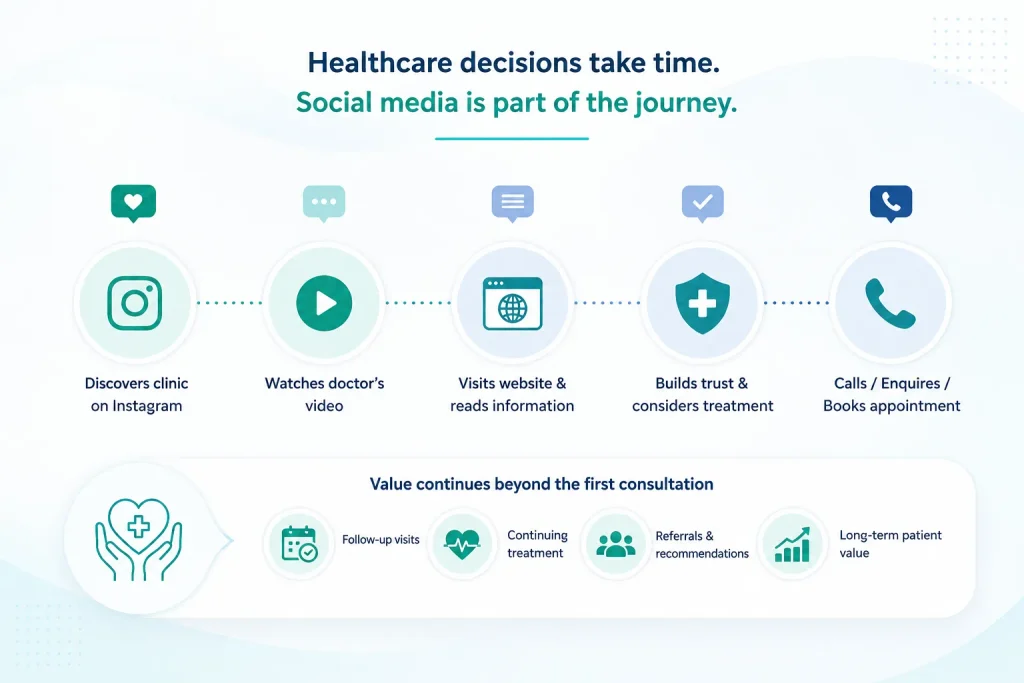
Healthcare social media ROI works differently because patients usually do not make healthcare decisions immediately. Someone may see a doctor’s video today, visit the website later, read about the treatment and finally contact the clinic after discussing the decision with their family.
Take a person searching for treatment for knee pain. They may first discover a clinic through Instagram. A few days later, they might watch another video from the same doctor. They could then visit the website, read patient information and finally call to enquire about an appointment.
If you only look at the final phone call, you may not realise that social media was part of that journey.
Healthcare also depends heavily on trust. People want to understand the doctor, treatment and hospital before making a decision. Educational content can therefore influence a patient even when it does not produce an immediate enquiry.
The value of a patient can also extend beyond the first consultation. Follow-up visits, continuing treatment and referrals may all contribute to the overall value generated by that patient.
How to Calculate Social Media ROI for Healthcare, Step by Step
To calculate social media ROI for healthcare, compare the value generated through social media with the total amount spent on the activity. Clear goals, conversion tracking, complete cost calculation and realistic values for patient actions are needed before calculating the final figure.
Step 1: Calculate your total investment.
Begin by working out how much the social media activity actually costs.
This can include advertising spend, content production, photography and video, agency charges, employee time, design work, social media tools and other expenses related to the campaign.
Including these costs gives you a more realistic picture of what was invested.
Step 2: Decide what counts as value.
Not every healthcare organisation will measure value in exactly the same way.
For a clinic, a WhatsApp enquiry might be an important conversion. For a hospital, a booked consultation or completed treatment may carry greater value.
Decide which actions matter to your organisation before starting the calculation.
Step 3: Track where enquiries come from
It is important to know how a person reached you.
UTM parameters can be added to campaign links so website visits from different social media campaigns can be identified. Website analytics, call tracking, enquiry forms and CRM records can add further information.
Your front desk can also ask a simple question during the enquiry: “How did you hear about us?”
Even this small step can improve the quality of your marketing data.
Step 4: Calculate the ROI
Once the investment and generated value are known, use the formula:
ROI = ((Value Generated − Investment) / Investment) × 100
For example, suppose a campaign costs ₹50,000 and generates ₹2 lakh in attributable patient value.
ROI = ((₹2,00,000 − ₹50,000) / ₹50,000) × 100 = 300%
The campaign therefore generated a 300% return on the investment made.
Step 5: Review the numbers regularly.
One campaign rarely tells the whole story.
Healthcare decisions can take time, so it is useful to review results monthly and look at broader trends over a quarter. This can show which campaigns consistently bring relevant enquiries rather than relying on the performance of one post.
Mapping the Healthcare Social Media Funnel
A healthcare social media funnel takes a person from discovering a healthcare brand to considering its services and, eventually, taking action. These stages are commonly described as awareness, consideration and conversion.
At the awareness stage, people may see a doctor’s video, educational post or hospital campaign for the first time. Reach and impressions are useful here.
During consideration, people may visit the doctor’s profile, website or treatment page. They may save posts, watch more videos or click on a link to learn more.
The conversion stage is where the person takes a more direct step, such as making a call, sending a WhatsApp message, submitting an enquiry or booking an appointment.
The numbers will not always move neatly from one stage to the next. Someone may discover a hospital on Instagram and return through Google weeks later. That is why looking at the wider patient journey gives a better picture than relying on one metric.
Social media has also become an important channel for healthcare communication and patient engagement. Research has highlighted its use for sharing health information, interacting with patients and building healthcare relationships. (Moorhead et al., 2013)
For a broader approach to building this journey, healthcare organisations can also explore social media strategy for healthcare.
Social Media Marketing KPIs Every Hospital and Clinic Should Track
The most useful healthcare social media KPIs connect online activity with enquiries, appointments and patient acquisition.
| Metric | Description |
| Engagement rate | Engagement divided by reach shows content quality, not just volume. |
| Click-through rate | How many people who saw your content actually took the next step? |
| Cost per enquiry | Total spend divided by number of tracked enquiries from social |
| Enquiry to appointment conversion rate | How many enquiries actually convert into a booked consultation |
| Patient acquisition cost | Total cost divided by number of new patients acquired through social |
| Average patient lifetime value | What a typical patient is worth across their full relationship with your practice, not just their first visit. |
| Follower quality over follower count | Local, relevant followers who could realistically become patients matter more than a large but geographically irrelevant audience. |
There is no need to give every metric the same importance.
A local clinic may care most about enquiries and appointment bookings. A large hospital launching a new service may first be interested in reach and awareness.
The metrics should follow the purpose of the campaign.
For doctors looking specifically at what to post and where to post, Social Media Marketing for Doctors: What to Post, Where to Post & How Often provides a related perspective.
Can You Really Measure the ROI of Your Social Media Marketing in a Hospital Setting?
Yes, hospitals can measure social media ROI when they have a reliable way of connecting social media activity with enquiries and patient conversions.
The difficult part is that the journey is rarely direct.
A patient might watch a reel, leave Instagram, and search for the hospital on Google several days later and then call the hospital. If the hospital only records Google as the source, the earlier social media interaction disappears from the picture.
This is where attribution becomes useful.
UTM links, website analytics, call tracking, CRM information and patient source data can be used together to understand how different channels contribute to the final enquiry.
There is another side to measurement as well. A social media post may educate someone about a symptom or treatment without producing an immediate appointment. That content can still have value, particularly in healthcare, where people often spend time researching before contacting a provider.
Common Mistakes Hospitals Make When Measuring Social Media ROI
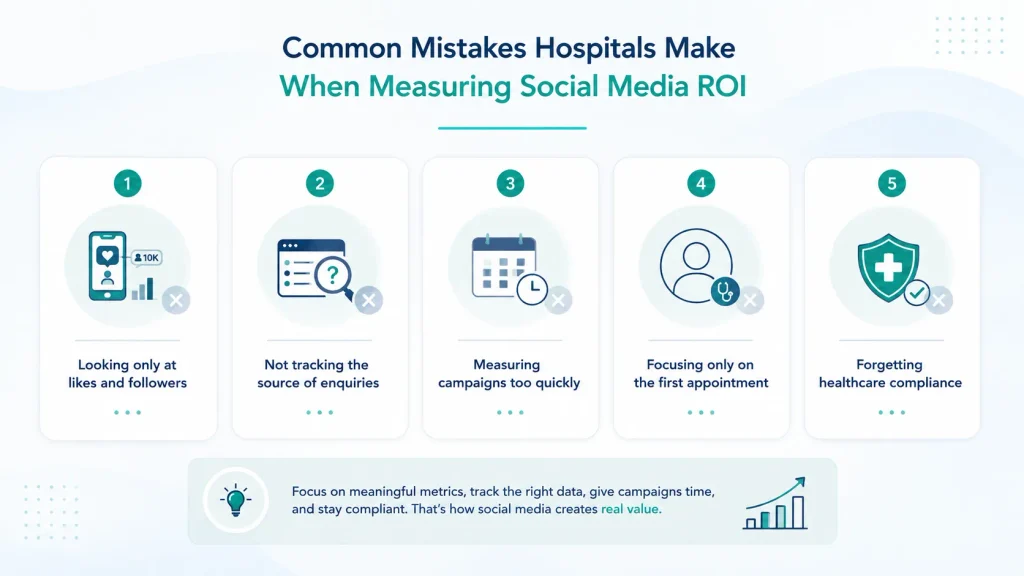
Looking only at likes and followers
A large follower count looks impressive, but it does not automatically mean that the account is bringing patients to the hospital.
A smaller audience made up of people living in the hospital’s service area may be far more useful than thousands of followers who cannot realistically become patients.
For more ideas on creating content that attracts relevant audiences, see 10 Social Media Post Ideas for Healthcare Practices.
Not tracking the source of enquiries
If every digital enquiry is simply recorded as “online”, it becomes difficult to understand which channel produced it.
Recording whether the person came from Instagram, Facebook, Google, the website, WhatsApp or another source can make future marketing decisions much easier.
Measuring campaigns too quickly
Not everyone who sees a healthcare post is ready to book an appointment.
Some people need time to compare doctors, understand treatment options or speak with their family. Measuring a campaign too early can therefore make a useful campaign appear unsuccessful.
Focusing only on the first appointment
The first consultation is not necessarily the full value of a patient.
Depending on the type of healthcare service, the patient may return for follow-ups, continue treatment or recommend the doctor to someone else.
This is why patient lifetime value can be more useful than looking at the first appointment alone.
Forgetting healthcare compliance
Healthcare marketing needs an additional layer of care because the information being communicated can influence health decisions.
Medical claims should be supported and communicated responsibly. Patient information must also be handled appropriately, and marketing should follow the relevant professional and advertising requirements.
Good healthcare content can still be engaging without making exaggerated promises.
How Healthus.ai Helps Hospitals and Clinics Measure Real Social Media ROI
This is where Healthus.ai brings clarity to social media ROI.
For hospitals and clinics, the value of social media lies not only in how many people see a post, but in what happens next. Healthus.ai brings engagement, enquiries and patient conversions into one transparent analytics dashboard, making it easier to see which content and campaigns are delivering meaningful results.
Social media also works best when it is connected. By bringing together local SEO, Google Business Profile, patient acquisition funnels and centralised lead management, Healthus.ai helps turn digital interest into genuine enquiries and confirmed appointments.
Every campaign is developed with healthcare compliance in mind, allowing practices to grow their presence while protecting the trust they have built with patients.
Healthus.ai healthcare social media marketing services are designed around healthcare marketing needs and can help hospitals and clinics bring their digital marketing and patient acquisition data into a more connected view.
Conclusion
Measuring social media ROI in healthcare is about more than counting likes, views or followers. It is about finding out whether social media is helping the right people discover your hospital or clinic and eventually take meaningful action.
Start with a clear goal. Then track the enquiries, appointments and patient value connected to your social media activity.
Engagement still matters, but it needs context. A post with 100,000 views may not be as useful as one that reaches 10,000 relevant people and brings 20 genuine enquiries.
The strongest social media strategy is therefore not necessarily the one with the biggest numbers on the screen. It is the one that connects those numbers to real business and patient outcomes.
For hospitals and clinics looking to better understand the connection between social media activity and patient acquisition, Healthus.ai offers healthcare-focused marketing and analytics solutions.
References
Moorhead, S.A., Hazlett, D.E., Harrison, L., Carroll, J.K., Irwin, A. and Hoving, C. (2013) ‘A new dimension of health care: systematic review of the uses, benefits, and limitations of social media for health communication’, Journal of Medical Internet Research, 15(4), e85.
Tandoc, E.C., Lim, Z.W. and Ling, R. (2018) ‘Defining “Fake News”: A typology of scholarly definitions’, Digital Journalism, 6(2), pp. 137–153.
Frequently Asked Questions (FAQs)
Social media ROI shows whether the value generated through social media is greater than the money and resources invested in it. For healthcare, this may include enquiries, consultations, appointments, treatments and longer-term patient value.
Use ((Total Value Generated − Total Investment) / Total Investment) × 100. Include relevant advertising, content, staff, agency and technology costs when calculating the investment.
Yes. UTM parameters, website analytics, CRM records, call tracking, enquiry forms and patient source information can help connect social media activity with enquiries and appointments.
Useful KPIs include engagement rate, click-through rate, cost per enquiry, enquiry-to-appointment conversion rate, patient acquisition cost and average patient lifetime value.
Healthcare decisions often take longer because patients want to research the doctor, treatment and hospital before making a decision. Social media may therefore influence an appointment without being the final source recorded for that patient.
Healthus.ai helps healthcare organisations connect digital marketing activity with patient enquiries and acquisition, making it easier to understand which marketing efforts are contributing to patient growth.