





What You’ll Learn From This Guide
|
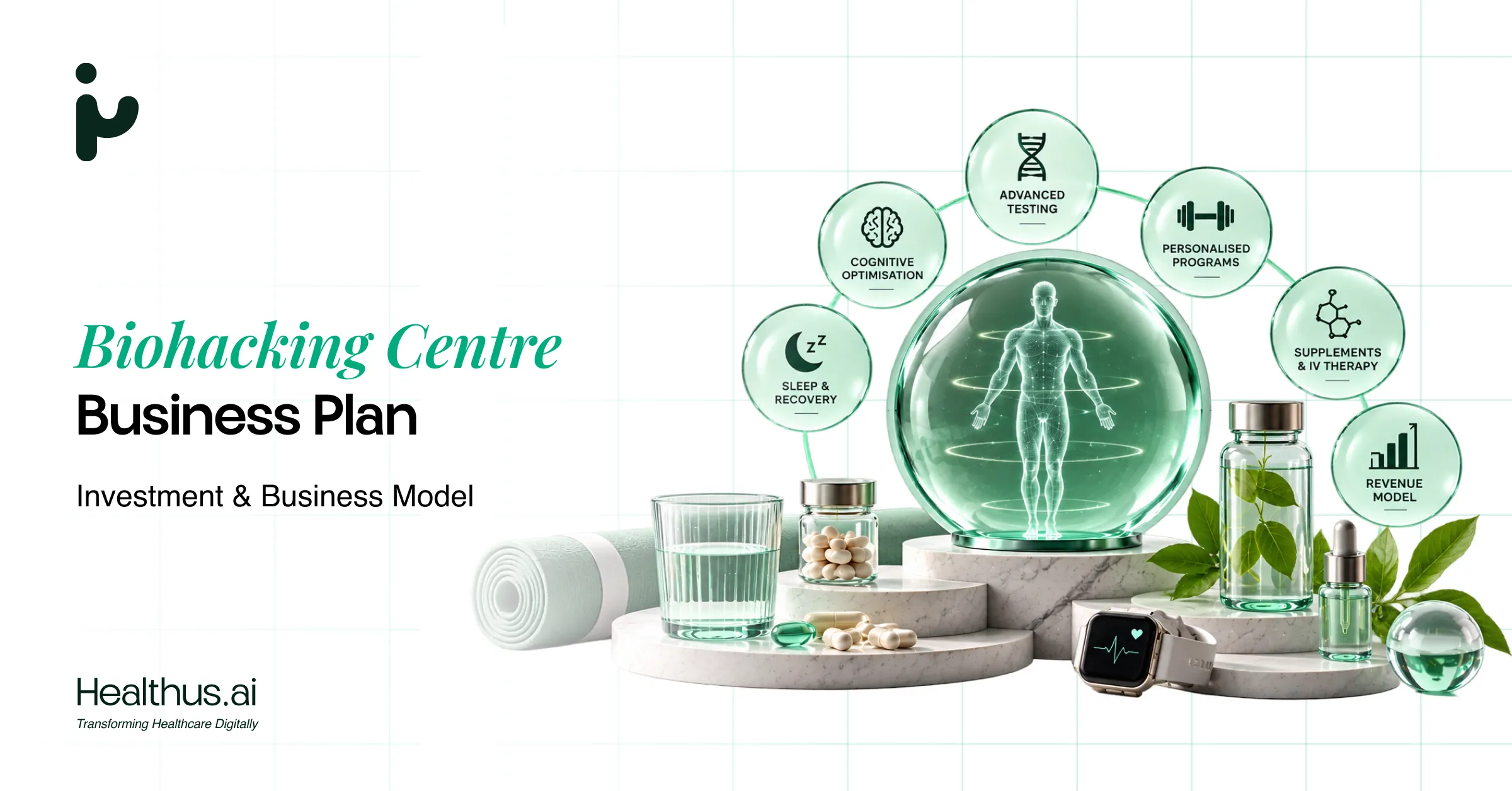
A biohacking business plan is a document that shows how your centre will turn expensive equipment and diagnostics into predictable revenue. It covers your business model, your pricing tiers, your investment requirement, and how equipment utilisation actually translates into monthly income.
This guide focuses on building that plan, the business model choices, the pricing structure, and the financial questions investors ask before funding a biohacking centre. For the licensing checklist and step-by-step setup process, see our complete guide on how to start a biohacking business in India.
“A cryotherapy chamber sitting empty for six hours a day is not an asset, it is a cost. The business plans that actually get funded show how many sessions a day each piece of equipment needs to run just to break even.”
— Dr. Hesha Kagrana, Senior Growth Manager, Healthus.ai
What Should a Biohacking Business Plan Actually Cover?
A biohacking business plan needs six parts, an executive summary, your business model, your pricing tiers, your investment and financial plan, your compliance and equipment snapshot, and your growth and retention plan. A strong business plan shows not just which technologies you will offer, but how equipment like red light therapy, PEMF and cryotherapy can contribute to the centre’s revenue and growth.
| Section | What to Include | Why It Matters |
| Executive Summary | Your centre concept, target customers, location, and funding needs | Gives investors or lenders a quick idea of what you are planning |
| Business Model | How the centre will make money through sessions, memberships, packages, or a combination | Helps you understand where your income will come from |
| Pricing and Packages | Individual session prices, packages, memberships, and personalised programmes | Helps you set prices that are practical for both your patients and your business |
| Investment and Financial Plan | Setup costs, monthly expenses, equipment costs, working capital, and expected break-even period | Helps you understand how much you need to invest and when you can expect the centre to start covering its costs |
| Compliance and Equipment | Medical supervision, required approvals, equipment standards, and protocols for services such as IV therapy | Helps you plan for the safety and regulatory requirements of the centre |
| Growth and Patient Retention | How you will attract new patients, encourage repeat visits, and build lasting patient relationships | Helps you create a steady flow of patients and build the centre over time |
Building a biohacking business plan and need the growth numbers to back it up?
What Biohacking Business Models Actually Generate Revenue?
Biohacking centres in India generally earn revenue through one of four models, pay-per-session, membership or subscription, diagnostics-led packages, or a hybrid combining several of these with corporate contracts. Picking a business model before finalising your equipment list keeps your plan focused on revenue.
| Business Model | How It Works | Best Suited For |
| Pay Per Session | Clients pay for each session, such as red light therapy, cold plunge, EMS, or other recovery services. | Centres looking to attract new clients with an easy and low commitment option |
| Membership or Subscription | Clients pay a monthly or yearly fee for a set number of sessions or regular access to services. | Clients who want to make recovery or wellness part of their regular routine |
| Diagnostics Led Packages | Clients pay for health assessments such as genetic tests, biomarker panels, or microbiome tests along with a follow-up plan. | Centres focused on personalised health and measurable progress |
| Hybrid with Corporate Contracts | The centre combines memberships with wellness programmes for employees of companies. | Centres that already have regular demand and want to serve both individual and corporate clients |
A realistic biohacking business plan usually blends at least two of these, session-based pricing to attract first-time clients, and a membership or diagnostics layer to build the recurring revenue an investor actually wants to see.
How Should You Structure Pricing Tiers for a Biohacking Business Plan?
Pricing in a biohacking business plan should move from a low-commitment entry point toward higher-margin, higher-expertise offerings. A workable structure looks like a single-session tier for trial clients, a package tier for regular users, and a diagnostics-led tier for clients seeking a fuller health optimisation plan.
- Entry tier: individual sessions of red light therapy, cold plunge, compression or sauna, priced to convert curiosity into a first visit
- Package tier: bundled multi-session packages across two or three recovery therapies, priced to improve visit frequency and predictability
- Diagnostics-led tier: biomarker testing, genetic or microbiome analysis paired with a personalised programme, priced to reflect professional expertise and follow-up support
Showing this progression in your plan tells an investor how a first-time client is expected to move toward higher-value services over time, which is a stronger signal than a flat price list for each machine in the centre.
How Do You Build the Financial Plan Without Guessing the Numbers?
The financial section of a biohacking business plan should show your setup investment, your monthly running cost, an equipment utilisation assumption, and your break-even timeline based on realistic session volume. Since biohacking equipment is one of the biggest investments in your centre, your business plan should show how each major piece of equipment can contribute to daily revenue. Estimate the number of sessions you expect to offer each day and set this against your planned pricing. This gives you a clearer picture of equipment usage, expected income, and how the investment can support the growth of your centre.
Common Mistakes Founders Make When Writing a Biohacking Business Plan
- Listing equipment and technology without a business model behind it, leaving no clear answer for how each machine earns its cost back
- Assuming full equipment utilisation from month one instead of building a realistic ramp-up curve into the financial plan
- Leaving equipment maintenance, calibration and depreciation costs out of the monthly running cost projection
- Treating diagnostics and IV therapy revenue the same as recovery session revenue, when the compliance and staffing costs behind each are very different
- Skipping a retention or membership conversion assumption, which leaves the plan dependent on a constant stream of new, one-time clients
Quick Summary
| Area | What You Need to Know |
| Core plan sections | Executive summary, business model, pricing tiers, financial plan, compliance snapshot, growth plan |
| Business models used in India | Pay-per-session, membership or subscription, diagnostics-led packages, hybrid with corporate contracts |
| Pricing tier structure | Entry session tier, bundled package tier, and a diagnostics-led personalised programme tier |
| What investors check first | Revenue durability beyond novelty visits, realistic equipment utilisation, and planned medical oversight |
| Where to get exact costs | Use a verified cost breakdown by centre format rather than an estimated single figure. |
How Can You Attract More Patients to Your Biohacking Centre?
A successful biohacking centre needs more than the right equipment and services. You also need a clear plan to reach people who are actively looking for wellness, recovery, and health optimisation services and turn that interest into enquiries and appointments.
HealthUs.ai helps healthcare and wellness businesses build this patient acquisition journey. From SEO and healthcare content to digital marketing and conversion-focused strategies, Healthus.ai helps businesses improve their online visibility, reach the right audience, generate qualified enquiries, and build a steady flow of patients.
Whether you are preparing to launch a new biohacking centre or looking to grow an existing wellness business, Healthus.ai can help you build a digital strategy around your goals, services, location, and target audience.
If you’re building a biohacking business plan and want a growth strategy to match it, connect with Healthus.ai.
References
Fortune Business Insights (2026) Biohacking Market Size, Share and Industry Analysis.
Research and Markets (2026) Biohacking Market Report 2026.
Ajana, B. (2017) ‘Digital health and the biopolitics of the Quantified Self’, Digital Health, 3.
Frequently Asked Questions
A biohacking business plan is a document that shows how your centre will earn revenue, which business model and pricing tiers it will use, what it will cost to set up and run, and how it plans to acquire and retain clients.
Most biohacking centres in India use a hybrid model, session-based pricing to attract first-time clients, paired with a membership or diagnostics-led package to build recurring revenue.
A biohacking business plan needs much stronger equipment utilisation and a financial model, since the business depends heavily on high-cost equipment like cryotherapy chambers and PEMF devices earning back their cost through consistent session volume.
Yes. Investors and lenders expect to see how you plan to handle medical device compliance, IV therapy protocols where applicable, and medical oversight for any diagnostic or clinical service, since these directly affect staffing cost and risk.
A first-year plan should prioritise session-based recovery services like red light therapy, cold plunge and EMS, since these convert new clients quickly, before adding capital-intensive diagnostics or IV therapy once demand is proven.
Investment requirements vary widely by format, from a lean recovery and performance lounge to a full medical biohacking clinic with advanced equipment, so the financial section of your plan should be based on a verified cost breakdown for the specific format you are building.