





Over the past decade, there has been a significant change in how patients locate doctors. Nowadays, before booking an appointment, most people search online using phrases like “doctor near me”, “best dermatologist nearby”, or “clinic open today”.
Medical practices are significantly impacted by this shift since patient growth is directly influenced by the presence in local search results.
Thus, local SEO for medical providers becomes utmost important in this situation. When properly executed, it enables physicians to reach local patients at the exact moment when they are seeking care, thereby eliminating the need for costly advertising or referrals.
This article describes how local SEO functions, why it is important for healthcare providers, and how they may use clever local SEO marketing techniques to draw in more patients over time.
Understanding Local SEO in Healthcare
Local SEO focuses on improving your online visibility mainly for location-based searches. Unlike traditional SEO, which targets a national or global audience, local SEO helps your practice rank for searches performed by people in your geographic area.
For example, a family needing urgent care will search for a “clinic open now” or a heart patient searching for “a cardiologist near me”. It is important to note that Google prioritises nearby, trustworthy, and relevant practices. If your clinic isn’t optimised locally, potential patients may never discover you even if your medical expertise is exceptional.
Therefore, this shows why local SEO for healthcare professionals is no longer optional but a foundational part of modern healthcare marketing.
Why Local SEO Matters for Doctors
Convenience and trust are the most essential factors in healthcare decisions. Patients frequently favour doctors that are easily accessible either via phone or online, have a high patient rating, are easily found in search results, and are also close to their place of employment or residence.
You gain the following advantages when your practice appears in local searches:
- Increased trust among patients
- Enhanced reputation on the internet
- A rise in the number of appointment requests
- Regular patient acquisition
How Can Doctors Increase Their Visibility Locally?
Understanding patient behaviour is key to successful local SEO and for healthcare professionals to grow professionally.
Most users now follow a similar journey: First, they search for symptoms or treatment online, then look for nearby doctors or clinics and compare their reviews and ratings. Additionally, they also visit websites or Google profiles and then finally call or book an appointment instantly.
This means your digital presence must answer patient questions quickly and build confidence before they even contact your clinic.
1. Optimise Your Google Business Profile
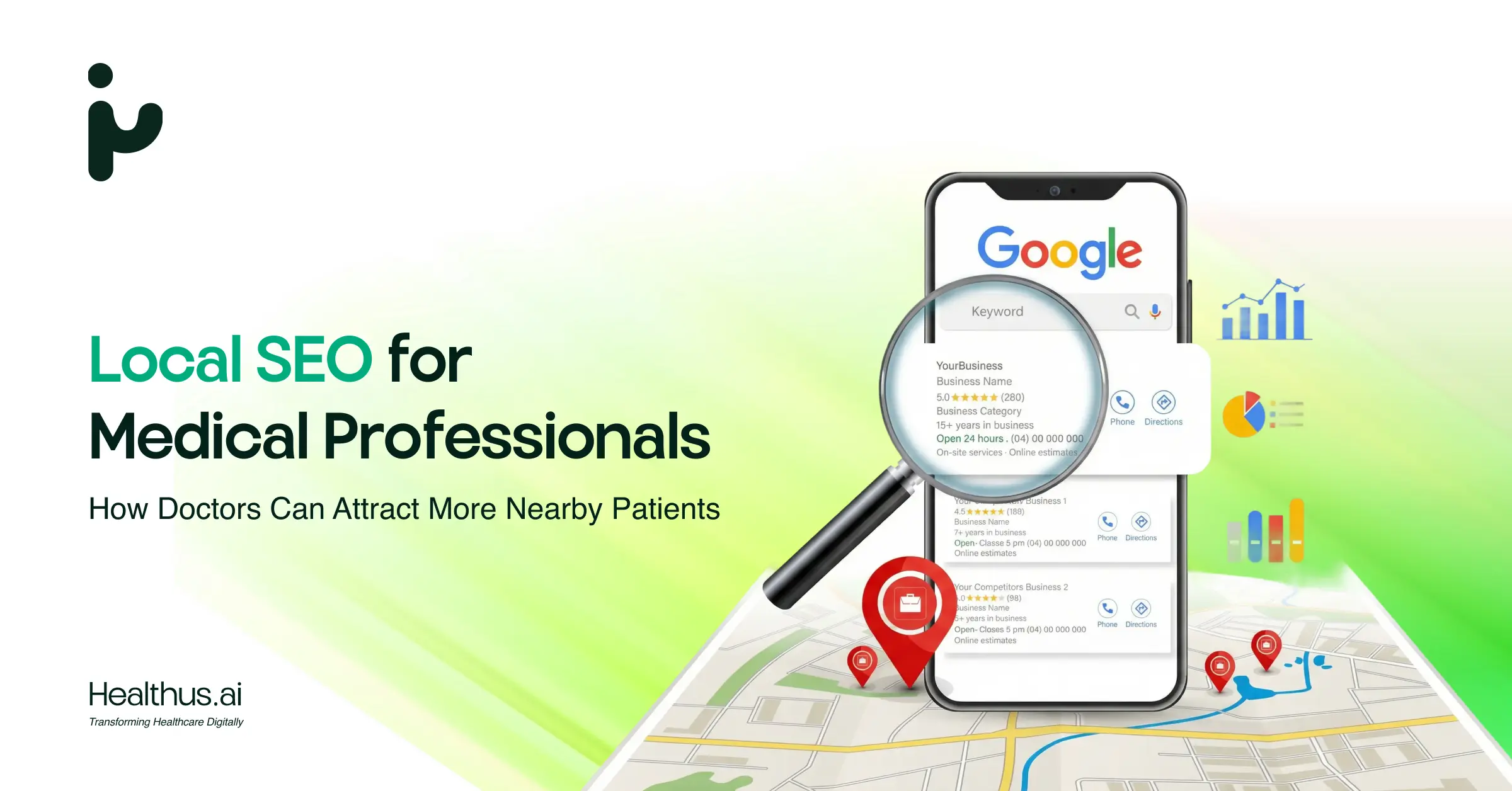
Your Google Business Profile is the most important asset in local SEO for medical professionals.
It often appears before websites in search engine results and heavily influences patient decisions.
Key optimisation steps include the following:
- Claiming and verifying your profile
- Adding precise clinic details
- Selecting correct medical categories
- Uploading professional clinic images
- Listing services and specialities offered
- Regularly updating operational hours
A well-optimised profile increases your chances of appearing in Google’s local map results which is one of the highest-converting areas in search.
2. Apply Local Keywords Strategically
Many practices misunderstand the use of keywords. It is important to understand that the goal isn’t repetition; it’s relevance. Local SEO for doctors works best when keywords are integrated naturally into useful content.
Examples include:
- Website homepage descriptions
- Service pages
- Blog articles
- Meta descriptions
- FAQs
Instead of forcing keywords, focus on clear communication. Mention your speciality, services, and location in a natural way. Proper keyword placement helps search engines understand who you serve and where you operate without sounding very robotic.
3. Create a Patient-Friendly Website
Your website is often the first impression patients have of your practice. Thus, it is very important to create a patient friendly website.
A strong medical website should:
- Load quickly on mobile devices and should be mobile friendly.
- Display contact information clearly.
- Include online booking options.
- Explain services in simple language.
- Provide doctor credentials and expertise.
If patients struggle to navigate your site, they will leave even if you rank well which will also affect the conversion rate.
4. Build Location-Specific Pages
Doctors serving multiple neighbourhoods or cities should create dedicated location pages.
Each page should contain:
- Unique local content
- Address and directions
- Nearby landmarks
- Services offered at that location
- Local testimonials
Avoid copying identical content across pages. Search engines favour authenticity and localised relevance.
5. Encourage Patient Reviews
Online reviews are one of the strongest signals for gaining trust in healthcare marketing.
Positive reviews influence both rankings and patient decisions.
Ethical ways to increase reviews include:
- Asking satisfied patients for their feedback after visits
- Sending follow-up messages
- Displaying review reminders at the reception
Equally important is responding professionally to all feedback. Engaging with feedback demonstrates to potential patients that you value their experiences and communication.
6. Maintain Consistent Practice Information
Consistency across the internet plays a crucial role in local SEO for medical providers.
Your clinic’s name, address, and phone number should match everywhere online, including:
- Medical directories
- Social media profiles
- Local business listings
Notably, inconsistent information confuses search engines and may reduce your visibility in local results.
7. Publish Helpful Medical Content
Educational and informative content builds authority and trust while supporting local search visibility.
Doctors can publish blogs addressing common patient concerns, such as:
- Preventive care tips
- Seasonal health issues
- Lifestyle advice
- Frequently asked medical questions
Content that educates rather than promotes helps establish credibility and positions your clinic as a trustworthy healthcare resource.
Over time, this strengthens both patient relationships and search performance.
8. Optimise for Mobile and Voice Search
Most local healthcare searches usually happen on smartphones.
Patients often use voice assistants to search for phrases like:
- “Find a dentist near me”
- “Doctor, open today near me.”
To support this behaviour:
- Ensure mobile responsiveness
- Use conversational language
- Include FAQ sections
- Provide quick contact buttons
Mobile optimisation is a critical component of modern local SEO doctors’ marketing.
9. Earn Local Backlinks and Community Mentions
Search engines view backlinks as signals of credibility.
Medical professionals can earn local backlinks by:
- Collaborating with wellness centres
- Participating in health camps
- Partnering with local organisations
- Contributing expert opinions to community publications
- Supporting local events
These connections strengthen both community reputation and online authority.
10. Use Data to Improve Your Strategy
Local SEO is an ongoing process, not a one-time setup.
Doctors should regularly monitor the following:
- Website traffic trends
- Appointment conversions
- Google Business Profile insights
- Search keyword performance
- Patient inquiry sources
Data helps identify what works and where improvements are needed.
Common Local SEO Mistakes Doctors Should Avoid
Even well-established practices sometimes struggle with local visibility due to avoidable mistakes.
- Ignoring Google Business updates
- Using outdated contact information
- Having slow websites
- Neglecting patient reviews
- Publishing overly promotional content
- Expecting instant results
Local SEO requires consistency and patience, but the long-term benefits are significant.
The Long-Term Value of Local SEO Doctors Marketing
When implemented strategically, local SEO delivers advantages beyond patient acquisition.
It helps practices:
- Build digital credibility
- Strengthen community presence
- Reduce dependency on paid advertising
- Improve patient trust before consultations
- Create predictable growth
Healthcare marketing is shifting from interruption-based advertising to discovery-based visibility. Patients now choose doctors they can easily find, research, and trust online.
Conclusion
Healthcare marketing today revolves around accessibility and trust. Patients want quick answers, nearby providers, and confidence in their healthcare decisions.
By investing in local SEO for medical professionals, doctors position their practices where modern patient journeys begin: online local search.
Effective local SEO for doctors doesn’t rely on aggressive promotion or keyword repetition. Instead, it focuses on helpful information, accurate listings, strong patient relationships, and community visibility.
When executed thoughtfully, local SEO doctors’ marketing becomes a reliable engine for attracting nearby patients, strengthening reputation, and ensuring steady practice growth for years to come.
Ready to increase your patients and improve your online visibility?
Let Healthus.ai manage your local SEO, from increasing search ranking to converting online queries into actual appointments, so that you can concentrate on patient care while your practice grows.
Frequently Asked Questions
Local SEO for medical professionals refers to optimising a medical practice’s online presence so it appears in location-based searches performed by nearby patients.
It improves visibility in local search results and Google Maps, allowing patients searching for nearby healthcare providers to discover and contact your practice quickly.
Most practices begin noticing improvements within three to six months.
Yes. Reviews influence both search engine rankings and patient trust. Practices with strong review profiles typically attract more appointments.
Yes. A website provides detailed information, builds trust, and allows deeper optimisation that supports local SEO performance.
Definitely. Local SEO prioritises relevance and proximity, allowing smaller practices to rank well when properly optimised.