





Healthcare Google Ads often get clicks without bookings because visitors hit friction points like slow landing pages, confusing booking forms, or a lack of mobile optimisation. Fixing these issues turns expensive traffic into real patient appointments.
Most healthcare setups face this situation, wherein, without knowing how much the doctors should spend on Google Ads, they spend on Google Ads, the Google Ads get lots of clicks, and yet the appointment book barely shows any growth. It’s not bad luck, and it’s usually not the ads either. A landing page that takes too long to load, a booking form that asks for more than they’re willing to give a stranger online, and a site that’s clearly built for desktop and awkward on the phone they’re actually using.
Each of these is a small moment where a genuinely interested patient quietly gives up and leaves. So the clicks-without-appointments problem usually isn’t one issue. It’s a stack of smaller ones, each quietly leaking a percentage of traffic before it ever reaches the front desk. Here are the ten that show up most often.
1. The Landing Page Doesn’t Match What the Ad Promised
Someone clicks an ad for “same-week orthopaedic consultation” and lands on a generic hospital homepage with twelve specialities listed and no mention of orthopaedics anywhere above the fold. That mismatch, known as poor message match, is one of the fastest ways to lose a visitor and is one of the healthcare marketing mistakes. They arrived expecting one specific thing and now have to hunt for it, and most people simply won’t.
2. Nobody Trusts the Page in the First Few Seconds
Long before a visitor reads your copy, they’re making a judgement about whether your site looks credible.
Foundational research on web credibility found that people form this impression almost instantly, largely from visual design and structure, before they’ve processed a single sentence [(Fogg et al., 2001; Fogg et al., 2003)].
For a healthcare page specifically, that first impression carries even more weight, since visitors are also silently checking for real doctor names, credentials, and evidence that an actual clinic exists behind the ad.
3. The Page Is Built for Desktop, Not the Phone in Someone’s Hand
Most healthcare ad clicks happen on mobile, often from someone searching mid-symptom, sitting in a parking lot, or scrolling one-handed while distracted. A landing page that loads slowly, requires pinch-zooming, or buries the phone number three scrolls down loses people who were otherwise ready to act.
4. Booking Requires Too Many Steps
A hospital page which is not converting visitors into patients, may include a ten-field intake form before someone can even request a callback is a conversion killer. Every additional field is one more reason to abandon the page. The fix isn’t complicated. Just ask for a name and phone number, and gather the rest later, either by phone or once they’ve actually engaged.
5. Every Landing Page Says the Same Generic Thing
A campaign for cardiac consultations and a campaign for paediatric vaccinations shouldn’t send traffic to the same identical hospital page. Generic pages read as generic care, and in a category where trust is the entire product, generic doesn’t convert. Specific pages for specific concerns consistently outperform one-size-fits-all pages, because they speak directly to what the visitor searched for.
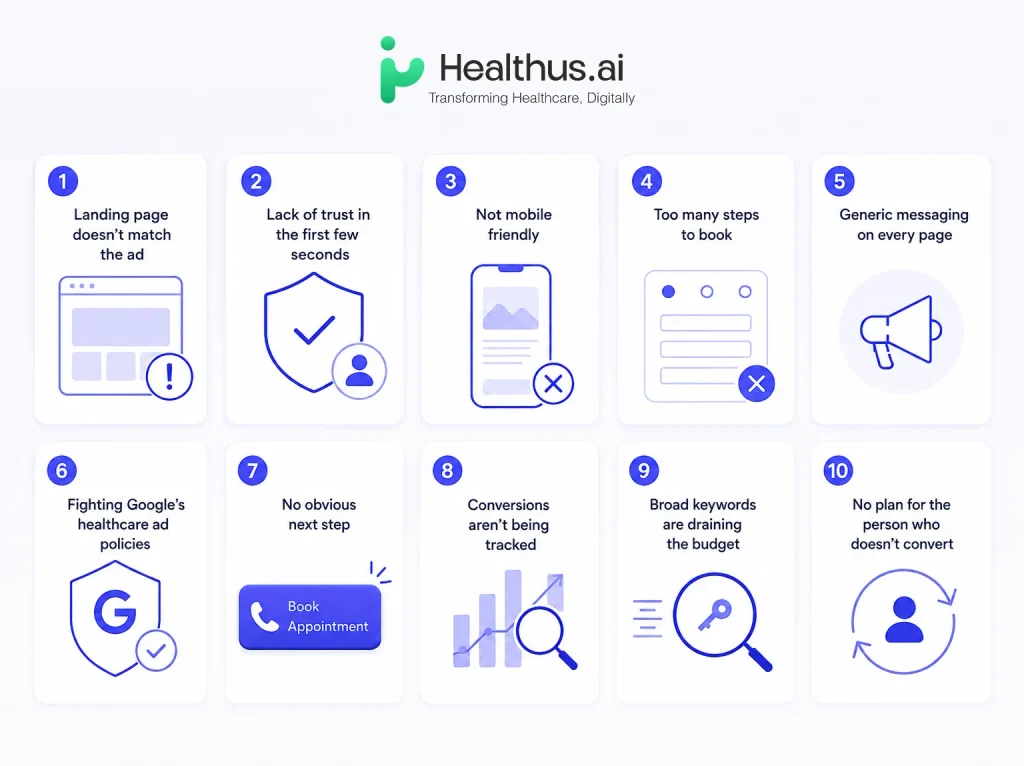
6. Campaigns Are Fighting Google’s Healthcare Ad Policies Instead of Working With Them
This one is unique to the category. Google restricts personalised advertising, remarketing, and any targeting that implies knowledge of someone’s health condition.
Healthcare advertisers who don’t understand this often build campaigns that get marked as a problem, held back, or deliberately slowed down without ever knowing why their reach dropped. Working within the policy, focusing on compliant search intent rather than inferred health status, tends to produce steadier and more sustainable results.
7. There’s No Obvious Next Step
A landing page that is one of an important digital marketing tool, with a wall of text and a small “Contact Us” link buried in the navigation isn’t asking for a conversion, it’s hoping for one. A visible phone number, a clear “Book Appointment” button, and one obvious action above the fold make the difference between a visitor who converts and one who leaves to keep comparing options.
8. Conversions Aren’t Actually Being Tracked
A lot of healthcare practices are converting more than their dashboard shows. Phone calls, WhatsApp enquiries, and walk-ins prompted by an ad rarely get tied back to the campaign that caused them. Without call tracking and proper conversion attribution, marketing teams end up optimising blind, cutting keywords that were actually working and keeping ones that weren’t.
9. Broad Keywords Are Draining the Budget
High-volume terms feel productive because the click numbers look good, but a lot of that traffic is browsing, not deciding. Tighter, higher-intent keywords, the ones closer to “book an appointment” or a specific condition, tend to cost less per conversion even when they cost more per click.
10. There’s No Plan for the Person Who Doesn’t Convert Today
Healthcare decisions rarely happen in one sitting. Research on patient information-seeking behaviour consistently shows that people research conditions and providers over days or weeks before ever booking, often returning to the same information multiple times before acting [(de Looper et al., 2021].
A campaign that treats every non-converting click as a lost cause, instead of someone still in that research window, is leaving a large share of eventual patients on the table.
Bringing It Together
These problems don’t just add up, they multiply. A slow, generic page with a long, ten-field form and no tracking doesn’t just lose someone once. It loses them at four or five different moments along the way, like when the page takes too long to load, when they can’t find what the ad promised, when the form feels like too much effort, when there’s no clickable number to just call instead.
Fix even two or three of those, and you’ll usually see a bigger jump in bookings than you would by simply throwing more money at ads.
But there’s a bigger point buried in all of this, and it’s easy to lose sight of when you’re deep in optimising for clicks. The person clicking that ad isn’t shopping for a pair of shoes. They’re making a decision about their health, often while worried or unsure.
A page that treats that seriously while being clear, honest and easy to act on tends to win the appointment.
If your healthcare ads are bringing in clicks but not enough bookings, that’s usually a funnel problem, not an ad problem. The team at Healthus.ai can help you pinpoint exactly where patients are dropping off and fix it, so the traffic you’re already paying for finally turns into filled appointments.
References
de Looper, M., van Weert, J.C.M., Schouten, B.C., Bolle, S., Belgers, E.H.J., Eddes, E.H. and Smets, E.M.A. (2021) ‘The influence of online health information seeking before a consultation on anxiety, satisfaction, and information recall, mediated by patient participation: field study’, Journal of Medical Internet Research.
Fogg, B.J., Marshall, J., Laraki, O., Osipovich, A., Varma, C., Fang, N., Paul, J., Rangnekar, A., Shon, J., Swani, P. and Treinen, M. (2001) ‘What makes web sites credible? A report on a large quantitative study’, Proceedings of the SIGCHI Conference on Human Factors in Computing Systems. Stanford: Persuasive Technology Lab, Stanford University.
Fogg, B.J., Soohoo, C., Danielson, D., Marable, L., Stanford, J. and Tauber, E.R. (2003) ‘How do users evaluate the credibility of web sites? A study with over 2,500 participants’, Proceedings of the 2003 Conference on Designing for User Experiences. New York: ACM Press.
Frequently Asked Questions (FAQs)
Usually because of a gap between the ad and what happens after the click, mismatched landing pages, weak trust signals, slow mobile load times, long booking forms, or conversions that simply aren’t being tracked. It’s rarely one single cause.
It varies significantly by speciality and region, but healthcare landing pages that are specific, mobile-optimised, and low-friction typically convert meaningfully better than generic hospital pages. Benchmarking against your own historical data is more useful than chasing an industry average.
Google restricts personalised advertising and remarketing based on health conditions, which limits how healthcare advertisers can target and retarget users. Campaigns built around compliant search intent, rather than inferred health status, tend to perform more predictably over time.
Sending all ad traffic to one generic homepage instead of building dedicated, condition-specific landing pages. It’s one of the simplest fixes and often produces the fastest visible improvement in conversion rate.
Match the page content to the ad’s promise, load fast on mobile, keep the booking form short, show real doctor credentials and credibility signals, and make the next step, a call or booking button, impossible to miss.
Yes. A large share of healthcare conversions happen by phone rather than online form, and without call tracking, that activity doesn’t get attributed back to the campaign, making it look like ads are underperforming when they’re not.