





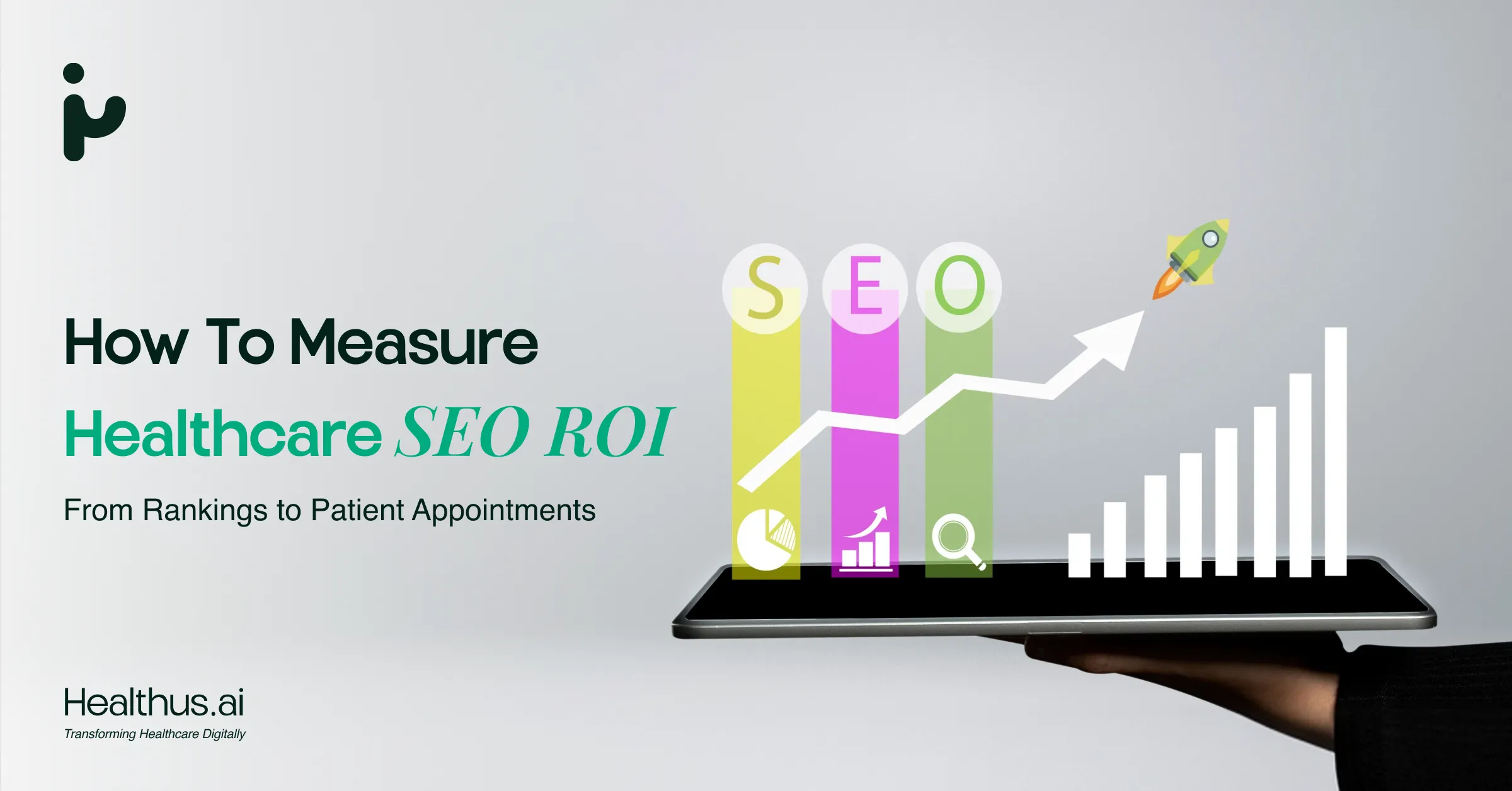
For healthcare executives, hospital marketing directors, and clinic leaders, digital marketing spend has to show up somewhere real. Agencies often hand over reports full of metrics, keyword rankings, organic impressions, and total site sessions, but not all of these numbers pay for clinical overhead or fill an empty treatment slot on Thursday afternoon, and we understand that.
In healthcare specifically, sitting at the top of the search results means very little if it never turns into a booked consultation, a confirmed appointment, or a patient who sticks around for years of follow-up care. Getting to the real picture of Healthcare SEO Return on Investment (ROI) means closing the gap between “people can find us online” and “people are actually in our clinic rooms.”
At Healthus.ai, we help our clients move toward a revenue-centric way of tracking performance, one that follows a search click all the way through to a completed appointment, without ever compromising HIPAA compliance along the way.
The Flaw of Metrics in Healthcare Digital Marketing
Plenty of healthcare organisations celebrate a #1 ranking for some broad medical term. But traffic and revenue aren’t the same thing, and leaning too hard on surface-level numbers creates real strategic blind spots:
- Informational vs. Intent Disconnect: A page ranking for something like “what causes knee pain” might pull in thousands of readers, most of whom just want to understand their symptoms, not book a surgery consult.
- Geographic Irrelevance: National rankings for high-volume keywords do almost nothing for a regional orthopaedic practice, unless that practice is actively courting patients from out of state.
- No Direct Tie to Capacity: More website visits tell you nothing about whether your highest-margin service lines, surgical procedures, specialised therapy, or elective treatments are actually booking up.
If the goal is accurate ROI, healthcare marketing has to shift its focus from search activity toward patient acquisition itself.
The Healthcare SEO Maturity Framework
Measuring ROI properly takes a layered approach, one where digital performance actually lines up with clinical growth. We think about healthcare search attribution across four levels of maturity:
Level 1: Search Visibility (Rankings, Impressions, Organic Clicks)
↓
Level 2: On-Site Engagement (Time on Page, Service Page Views)
↓
Level 3: Lead Generation (Form Submissions, Call Clicks, Booking Starts)
↓
Level 4: Attributed Patient Revenue (Scheduled & Completed Appointments)
Level 1: Visibility & Organic Reach
Metrics tracked here include SERP positions, impressions, and organic session growth over time. This level tells you about brand awareness and search authority across your service area.
Level 2: Engagement & Intent Filtering
This is about session duration, bounce rates, and whether visitors are clicking through to high-intent pages like physician bios, insurance verification, or location and directions. It’s a rough gauge of whether people are genuinely evaluating your practice or just passing through.
Level 3: Micro-Conversions & Lead Capture
Phone calls placed through tracked numbers, appointment forms submitted, and scheduling portals opened, this is where you start capturing real interest and where front-desk teams can find gaps in follow-up.
Level 4: Macro-Conversions & Revenue ROI
Confirmed visits, average lifetime value by speciality, and net revenue tied back to organic search, this is the number that actually means something to a hospital board.
Step-by-Step: Calculating Healthcare SEO ROI
The standard formula for calculating healthcare SEO ROI can look like this, based on the standard, universally accepted ROI calculation used across finance and digital marketing:
Healthcare SEO ROI (%) = Attributed Patient Revenue − Total SEO Investment X 100
———————————————————————-
Total SEO Investment
- Determine Average Patient Lifetime Value (LTV) by Speciality
Not every organic lead is worth the same amount. A primary care visit doesn’t carry the same long-term revenue as a cardiology treatment plan or an orthopaedic surgery. A rough breakdown:
- Primary Care / General Practice: lower initial visit value, but strong recurring value over several years
- Speciality / Surgical Services: high value on the initial procedure, with follow-up length that may vary quite a bit
- Urgent Care: one high-velocity visit, generally with little long-term retention
- Implement Closed-Loop HIPAA-Compliant Call Tracking
More than 60% of healthcare appointments still start with a phone call, not a form submission. Most standard analytics setups either miss this entirely or risk exposing patient data in the process. Dynamic, HIPAA-compliant tracking numbers solve this; they attribute calls back to organic traffic without ever storing or recording protected health information.
- Track Electronic Health Record (EHR) & CRM Conversions
To confirm that an online inquiry became a real, physical visit, marketing analytics need to connect with your CRM or practice management system. Mapping aggregated source data, say, “Organic Search / Google”, to completed appointments lets marketing teams trace revenue back to the original search query, all without touching individual patient records.
Need help understanding how healthcare SEO works? Speak to our SEO experts at Healthus.ai.
Regulatory & Technical Alignment in 2026
Search interfaces keep changing, and privacy regulation keeps tightening. Both make this measurement harder than it used to be.
Navigating Search Engine AI Summaries
As AI-generated summaries and direct answer boxes take up more space at the top of results pages, zero-click searches keep climbing. That means healthcare content now needs to be built for two audiences at once: people who click through to a website and the algorithms deciding which brand gets cited inside a summary box. A strong authoritative presence is what pushes high-intent users straight to a booking page instead of another informational article.
Balancing Data Tracking with Patient Privacy
Any attribution model has to hold up against HIPAA and federal rules on online tracking technologies. A poorly vetted pixel or third-party script can end up transmitting IP addresses or behavioural data tied to specific medical conditions, which is a real liability, not a hypothetical one. At Healthus.ai, our conversion tracking runs on server-side, privacy-compliant architecture, so practices get usable marketing data without putting patient trust at risk.
Executive Checklist: Healthcare SEO Measurement Readiness
Before you take your agency’s next performance report at face value, check your SEO against this list:
✔ Goal Segmentation: High-value speciality pages are tracked separately from general blog content
✔ HIPAA-Compliant Call Tracking: Dynamic numbers capture phone conversions without transmitting PHI
✔ EHR/PMS Alignment: Attribution ties back to completed appointments, not just unverified form fills
✔ LTV Modelling: ROI calculations reflect speciality-specific treatment value, not a flat number per lead
✔ Search Summary Optimisation: Content is built to earn authoritative citations and not just rankings
Build a Measurable, Patient-Centric Growth Engine
Visibility in search results is only the starting point. Growth happens when technical strategy, clinical authority, and compliant tracking all work together, driving patients who actually book and revenue that’s easy to prove.
At Healthus.ai, we help healthcare organisations move past surface-level metrics toward SEO strategies that are grounded in real revenue, built on patient privacy, and backed by clinical credibility.
Ready to measure the impact of your healthcare search strategy?
Book a strategy call with Healthus.ai today to build a compliant, high-converting patient acquisition system.
Frequently Asked Questions (FAQs)
Healthcare SEO optimises practice, hospital, and service-line pages so they rank when prospective patients search for treatments, symptoms, or nearby providers. Done well, it drives qualified traffic by demonstrating medical authority, building patient trust, and making it easy to book an appointment online.
In healthcare, this usually plays out as roughly 80% of patient acquisition and revenue coming from about 20% of your content and keywords, typically high-intent local service pages, physician directories, and procedure-specific landing pages, rather than general informational blog posts.
Yes. Even with AI-driven summaries reshaping search results pages, organic search remains one of the strongest-converting channels for new patients. Healthcare decisions lean heavily on trust and credentials, and organic visibility still builds that better than paid ads alone.
- On-Page SEO: Content optimisation, keyword placement, clinical E-E-A-T signals
- Off-Page SEO: Digital PR, medical directory citations, authoritative backlinks
- Technical SEO: Site speed, mobile responsiveness, architecture, HTTPS
- Local SEO: Google Business Profile optimisation, local reviews, map pack visibility
It does. Patient behaviour keeps shifting, but people still turn to search engines to check physician credentials, read reviews, find nearby clinics, and book appointments. Practices without a real SEO strategy end up losing high-intent traffic to competitors who have one.