





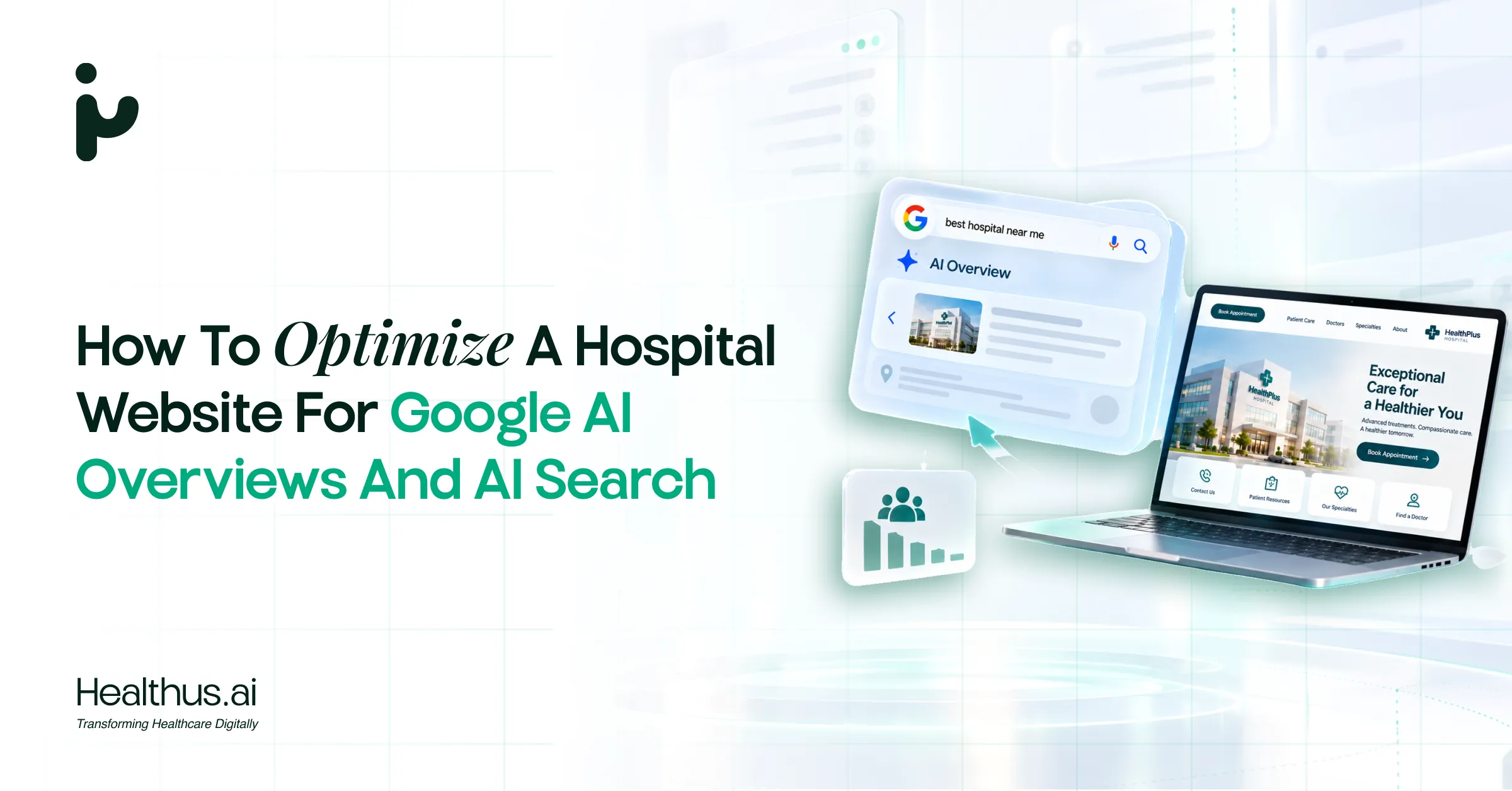
A practical Healthus.ai guide for hospital and healthcare marketing teams looking to improve visibility in Google AI Overviews and AI Mode without relying on unproven AI-search tactics
In brief
Optimising a hospital website for Google AI Overviews and AI Mode does not require a completely separate SEO strategy. Google says the same core search principles still apply. Hospitals should focus on making their website easy to access, useful to patients, clear about who provides the information and accurate about their services, rather than chasing new “AI-only” tactics.
Do Hospitals Need a Separate Strategy for Google AI Search?
Not really, at least not for Google.
AI search has created a new wave of terms such as GEO and AEO, and hospital marketing teams are increasingly being told they need a separate strategy for each one. Google’s own guidance is much simpler. It says that optimising for generative AI search is still part of optimising for Search overall (Google Search Central, 2026a). For a broader look at how healthcare content can be prepared for newer search experiences, see our guide to optimising healthcare content for AI search engines.
Google does use more advanced systems behind the scenes to build AI-generated answers, but hospital teams do not need to redesign their website around those technical processes. The practical question is much simpler: can Google clearly understand the hospital, its doctors, its services and the information on each page?
These newer search experiences still build on many of the same foundations covered in healthcare SEO, from useful content to technical accessibility.
Start With Whether Google Can Access and Understand Your Hospital Website
Before Google can consider a hospital page for AI Overviews or AI Mode, it first needs to be able to find and process it. The page must be indexed and eligible to appear in Google Search with a snippet, and Google says there are no additional technical requirements specifically for its AI features (Google Search Central, 2025).
In practice, the process means getting the basics right: making sure important pages are not accidentally blocked from search engines, checking that essential doctor and service information is available to Google, and it is important to ensure the site works properly across devices. JavaScript itself is not a problem, but Google notes that JavaScript-based websites can be more complex to optimise if important content is blocked or is difficult to process (Google Search Central, 2026a). It is the same technical foundation Google has relied on for Search for years, and it is still where a hospital website should start.
Make It Clear Who Your Hospital, Doctors and Services Are
Google recommends keeping local business information accurate and up to date because Google Business Profile data can help services appear in AI responses as well as other search results (Google Search Central, 2026a). For a hospital, that means getting the basics right and keeping them consistent: correct locations, current opening hours and services that are actually offered, with the same information reflected on the website. Hospital groups operating across several sites may also find our guide to local SEO for multi-location healthcare brands useful when structuring location pages and keeping information consistent
The same clarity should carry through the site itself. A department page is more useful when it names the doctors who work there and links to a proper profile for each one, rather than describing a speciality in general terms with no one attached to it. For more on strengthening location-level visibility, see our guide to local SEO for doctors and clinics
Replace Generic Healthcare Copy With Genuine First-Party Value
Google is fairly direct about what it wants to see more of: content that adds something useful and original rather than simply repeating what is already available elsewhere (Google Search Central, 2026a). For a hospital, that is a useful test to apply to existing pages. If a condition or treatment page could sit on almost any hospital website with only the name changed, it probably is not adding much distinctive value.
The stronger approach is to build in information the hospital can genuinely stand behind. That might include clinician input, clear explanations of how a service is organised, what patients can expect from an appointment, and practical information specific to that hospital. The important part is that these details come from real clinical or operational knowledge, not assumptions made for SEO.
Make Medical Information Easy to Trust
Health information can affect important decisions, which is why Google applies a higher quality bar to this type of content. Its guidance describes trust as the most important part of E-E-A-T, alongside experience, expertise and authoritativeness (Google Search Central, 2025b). E-E-A-T is not a single ranking factor or a separate checklist for AI features, but it helps explain the qualities Google wants reliable content to demonstrate. Healthus’s guide to E-E-A-T in healthcare content explains how these trust signals can be applied in practice.
Not sure how ready your hospital website is for Google Search and AI Overviews? Start with a focused SEO review.
Use Structured Data Correctly, Not as an AI-Search Hack
Structured data helps search engines understand information on a page, but hospitals do not need any special “AI schema” for Google AI Overviews or AI Mode. Google says there are no additional structured-data requirements for these features, and the usual rule still applies: the markup should accurately reflect what is visible on the page (Google Search Central, 2025a).
That means schema can still be useful for clearly describing doctors, organisations and other page information, but it should not be treated as a shortcut or guarantee for appearing in AI-generated results.
Healthus’s guide to schema markup for doctors explains how structured data can be used appropriately on healthcare websites.
What Hospitals Do Not Need to Do for Google AI Search
Google’s own guidance lists several tactics that hospital teams do not need to prioritise for AI Overviews or AI Mode (Google Search Central, 2026a).
| Tactic | What Google actually says |
| Adding an llms.txt file | Google Search does not use it, so it does not improve or reduce search visibility |
| Breaking content into small “AI-friendly” chunks | Not required; Google can understand different topics within a page |
| Rewriting content specifically for AI systems | No special AI writing style is needed |
| Seeking inauthentic online mentions | Not a useful shortcut; Google’s ranking and spam systems still apply |
| Adding structured data purely for AI inclusion | No special schema is required for generative AI search |
How Hospitals Can Measure AI Overview and AI Mode Visibility
Google Search Console now has dedicated reporting for visibility in generative AI features, including AI Overviews and AI Mode (Google Search Central, 2026c). Hospitals can see how often their pages appear, which URLs surface, and how visibility changes by country, device, and date.
The current report focuses on impressions. Google’s documentation does not list clicks or the specific queries or prompts that triggered an appearance, so it cannot tell a hospital the full patient journey from AI visibility to enquiry.
Hospitals still need to look at it alongside website enquiries, appointment tracking and other conversion data. Our guide to measuring healthcare SEO ROI explains how search visibility can be assessed alongside enquiries, appointments and other meaningful outcomes.
Practical Hospital AI-Search Website Checklist
Use this checklist as a quick first check before looking for more complicated AI-search fixes.
| Area | What to check |
| Access | Can Google reach and index important pages? Is essential content and functionality available on mobile? |
| Doctors and services | Can patients clearly see which clinicians, departments and services are available, with useful profile or service pages where relevant? |
| Local information | Do locations, opening hours and services match across the website and the Google Business Profile? |
| Content quality | Could the same page appear on almost any competing hospital website with only the hospital name changed? |
| Trust | Does published medical content clearly show appropriate authorship, review information and genuine publication or update dates? |
| Structured data | Does the markup accurately match information that is visible on the page? |
| Measurement | Is generative-AI visibility being reviewed alongside enquiries, appointments and other meaningful conversion data? |
This does not replace a full technical and content audit, but it gives hospital teams a practical place to start before investing in more elaborate AI-search tactics.
Start With a Proper Hospital Website Review
Most of what matters here is getting the groundwork right: pages Google can access, doctors and services that are clearly identified, information that stays consistent across the website and Google Business Profile, and medical content with clear authorship and appropriate review.
If your hospital website has not had a technical and content review recently, that is a better starting point than focusing on individual AI-search tactics.
Build a stronger search foundation with healthcare SEO designed for hospitals and healthcare brands.
References
Google Search Central (2025a) AI features and your website. Available at: https://developers.google.com/search/docs/appearance/ai-features
Google Search Central (2025b) Creating helpful, reliable, people-first content. Available at: https://developers.google.com/search/docs/fundamentals/creating-helpful-content
Google Search Central (2026a) Optimizing your website for generative AI features on Google Search. Available at: https://developers.google.com/search/docs/fundamentals/ai-optimization-guide
Google Search Central (2026b) Latest Google Search documentation updates. Available at: https://developers.google.com/search/updates
Google Search Central (2026c) Introducing Search Generative AI performance reports in Search Console. 3 June. Available at: https://developers.google.com/search/blog/2026/06/gen-ai-performance-reports
Schema.org (n.d.) FAQPage. Available at: https://schema.org/FAQPage
Frequently Asked Questions (FAQs)
No. Google says llms.txt is not needed for Google Search and does not positively or negatively affect visibility or rankings. (Google Search Central, 2026a).
Google does not recommend the FAQ schema as a way to improve AI Overview visibility. Its guidance says no special structured data is required for generative AI search. Separately, Google stopped showing FAQ-rich results in search from May 2026 (Google Search Central, 2025a; 2026b).
Google does not give a fixed timeline. A page needs to be indexed and eligible to appear in Search with a snippet before it can be considered for AI features, and even then, indexing and serving are not guaranteed (Google Search Central, 2025a).
Google Search Console’s generative AI performance report shows impressions, pages, countries, devices and dates for generative AI features (Google Search Central, 2026c). Third-party tools can still be useful for monitoring, but Google says none has access to its internal ranking or AI systems (Google Search Central, 2026a).