





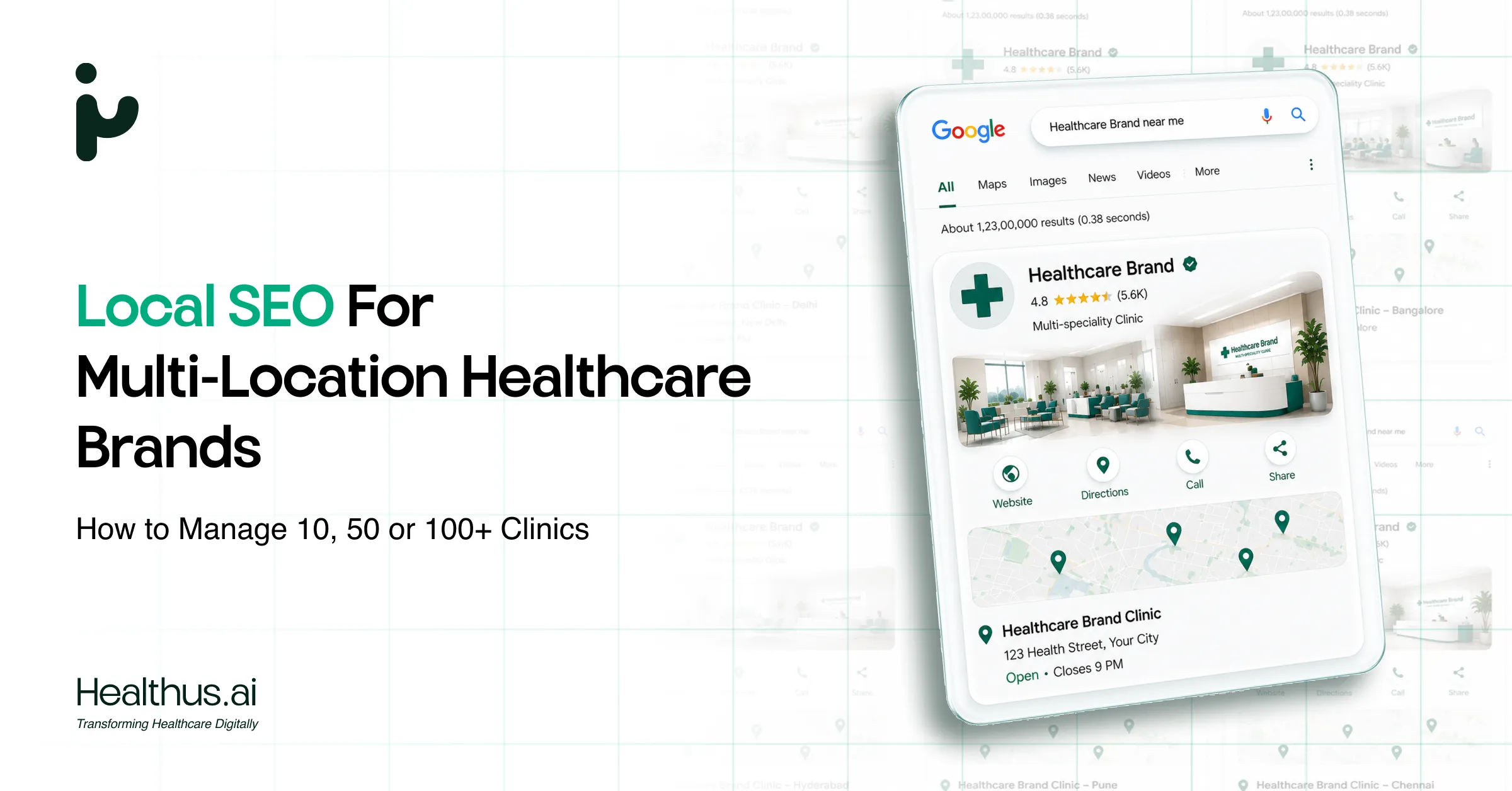
Local SEO for multiple locations is the process of helping every branch of a healthcare brand, not just the head office, show up and rank well when nearby patients search for care. It covers your Google Business Profile, your website, your reviews, and your listings, done correctly for each clinic on its own, not just for the brand as a whole.
If you run one clinic, you can usually keep all of this in your head. One profile, one set of reviews, and one address to keep correct. But once you cross five, ten, or fifty clinics, that mental checklist stops working. A location that used to show up at the top of local search results can quietly disappear, and you may not notice until a patient tells you.
If that sounds familiar, this is not a sign you have done something wrong. It is a sign your business has grown faster than your systems. Local SEO for multiple locations is a different job from single-location SEO, not just a bigger version of it. Once you see it that way, managing 10, 50, or even 100+ clinics starts to feel less like chaos and more like something you can actually run.
This guide explains what changes as you grow, what tends to break first, and how to build a local SEO system that holds up whether you manage ten clinics today or plan to manage a hundred.
What Does Local SEO for Multiple Locations Actually Mean?
Local SEO for multiple locations means making sure every clinic under your brand can be found by patients searching nearby, not just your head office or your busiest branch. It means managing rankings, listings, and reviews for many addresses at once, instead of optimising a single website for a single place.
For one clinic, local SEO is fairly simple. One well-set-up Google Business Profile, correct contact details, and a few local reviews cover most of it.
For a multi-location healthcare brand, that same work has to happen for every branch, on its own, while the whole brand still looks and feels like one trusted organisation. Get it right, and a patient in one town and a patient in the next town both find their nearest branch easily. Get it wrong, and Google starts trusting your listings a little less, often before you even notice why.
Why Local SEO Gets Harder, Not Easier, as You Add More Clinics
Local SEO does not get easier as you add clinics. It gets harder, because every new location adds more moving parts than the one before it. A brand with two clinics can often manage with a shared spreadsheet. A brand with fifty clinics, without a proper system, is usually fighting problems it cannot even see yet.
Here is what catches most healthcare brands off guard. It is rarely the big tasks that cause damage. It is the small, repeated ones that quietly pile up. One clinic’s phone number changes, and nobody updates the directory listing it appears on. Another clinic’s manager replies to reviews in a tone that does not sound like the rest of the brand. A new branch opens, and its Google Business Profile sits unverified for weeks while patients search for it anyway. None of these feel urgent on their own. But add them up across fifty locations, and the brand starts to look unreliable to Google and to patients, even though each clinic is doing fine by itself.
This is why many multi-location healthcare brands stop trying to manage this clinic by clinic. Instead, they build, or bring in, one central system that can see every location at once. If your growth has reached that point, Healthus.ai’s healthcare local SEO service was built for exactly this problem.
What Makes Multi-Location Healthcare SEO Different From Single-Location SEO
The core difference is simple. Single-location SEO focuses on ranking one place, whereas multi-location SEO has to do that for many places at once, without letting one location get in the way of another.
A single clinic competes with the three or four other clinics nearby. A hundred clinic brand, in a strange way, ends up competing with itself too. If two of your own branches serve nearby neighbourhoods with similar-looking pages, Google can struggle to tell them apart, and you may end up ranking worse for both instead of well for either. To avoid this, every location needs to feel distinct and genuinely local, while still clearly belonging to the same trusted brand.
How to Structure Your Website for 10, 50 or 100+ Clinic Locations
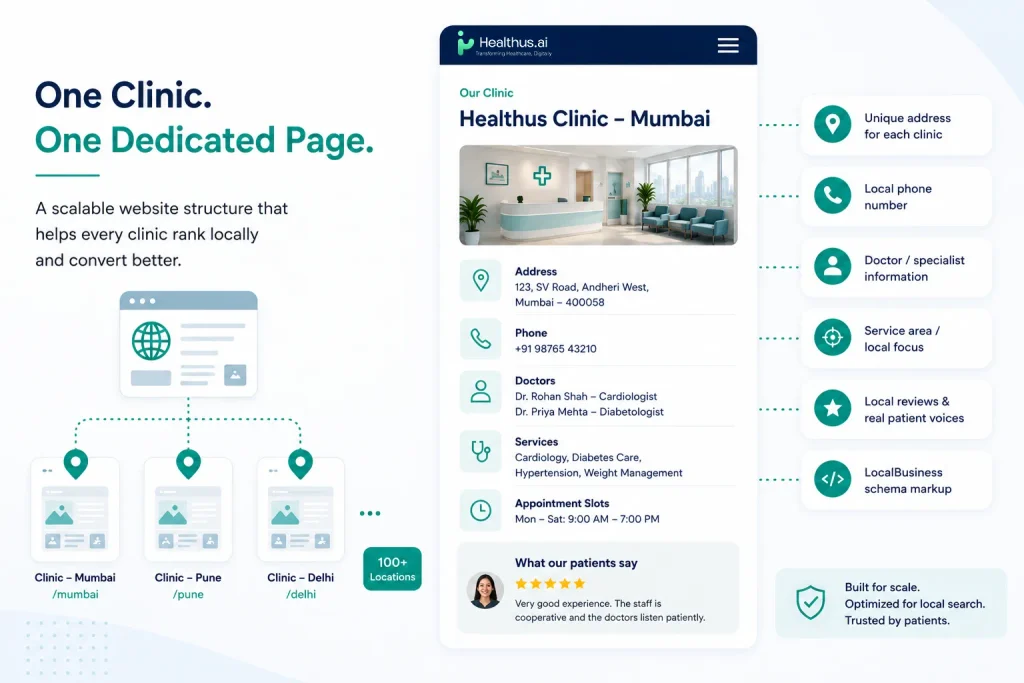
The right structure is one dedicated page for every clinic, built on a consistent template but filled with real, local content, not one generic “our locations” page trying to represent all of them. This single choice affects almost everything else that follows.
For optimising the location page according to the local SEO for clinics, each clinic page should include its own address, phone number, doctor or specialist names where relevant, service area, and a few honest local details, nearby landmarks, local patient reviews, or appointment slots specific to that branch. This, when supported by structured data called the LocalBusiness schema, which helps Google read your clinic’s details correctly instead of guessing at them. Templates make this manageable at scale, but the content inside each one still needs to be different. Thin, copy-pasted location pages are one of the fastest ways a hundred clinic brand ends up ranking worse than a single, well-built one.
Google Business Profile Management at Scale
Managing a hundred profiles is a different job entirely since it means running a proper system for verification, consistency, and monitoring, because at that scale, something is always changing somewhere. A new doctor joins, a branch changes its hours, a listing gets flagged, and without a system in place, you will not know until a patient tells you.
In practice, this means a clear structure, one person or team responsible for each region’s profiles, a regular check to catch wrong hours or outdated photos, and every profile claimed and verified under the brand’s own account, not left to whoever set it up years ago. This work is tedious at scale, and that is exactly why many multi-location brands choose to hand it off rather than manage it in-house.
NAP Consistency: Why the Smallest Detail Breaks Multi-Location SEO the Fastest
NAP consistency means your clinic’s Name, Address, and Phone number appear exactly the same everywhere online, on your website, on Google, in directories, and on social media. It matters because search engines use this consistency to decide how much to trust a listing. A small mismatch might look harmless to a person, “Clinic” versus “Clinic Pvt Ltd”, a landline listed in one place and a mobile number in another, but to Google, it can look like a sign the listing is not reliable.
For one clinic, checking this takes five minutes. Across a hundred clinics, it becomes one of the most common and most easily missed problems a healthcare brand can carry for years, simply because no one is ever looking at all hundred listings side by side. A regular NAP audit, checked against every directory and profile your brand appears on, is one of the simplest fixes with the biggest payoff in multi-location local SEO.
Local SEO KPIs to Track Across Every Clinic Location
The right way to track multi-location local SEO is clinic by clinic and not as one average for the whole brand. A strong flagship clinic can easily hide three struggling branches sitting right underneath it in the same report, and thus the following metrics should be a part of every hospital’s marketing strategy.
| Metric | What It Tells You |
| Map pack ranking by location | Whether each clinic shows up in the top three local results for its own area |
| Google Business Profile views per clinic | How visible each branch is before a patient even visits your website |
| Direction requests and calls per clinic | Real interest from people close to that specific clinic |
| Review volume and rating per clinic | Whether trust looks consistent or uneven across branches |
| Website traffic to each location page | Whether people are actually finding your location pages |
| Enquiry to appointment rate per clinic | Whether visibility is turning into real patients at that location |
Building a Review Management System That Scales With Your Clinic Count
A review system that scales means every clinic, not just your busiest one, has a simple, timely process for collecting new reviews and replying to every review, good or bad, in a tone that still sounds like your brand. Reviews shape a patient’s decision more than almost anything else on this list. Research into how patients choose doctors found that negative reviews clearly reduce a patient’s willingness to choose a provider and that how a doctor responds to criticism also shapes that choice (Han et al., 2024).
That finding matters here. An unanswered bad review at just one of your hundred branches is not only a local problem, it is a brand trust problem that a nearby patient may see before they ever visit any of your clinics, for which it is equally important to understand how to respond to negative patient review.
A workable system usually includes a shared response guide every branch manager can follow, a clear process for anything sensitive, and a steady habit of asking happy patients for reviews, so the good ones keep outweighing the rare bad ones.
Common Mistakes Multi-Location Healthcare Brands Make With Local SEO
The most common mistake is treating every location the same way you would treat a single clinic, instead of building a system for many places working together. A few patterns of common healthcare marketing mistakes should be avoided.
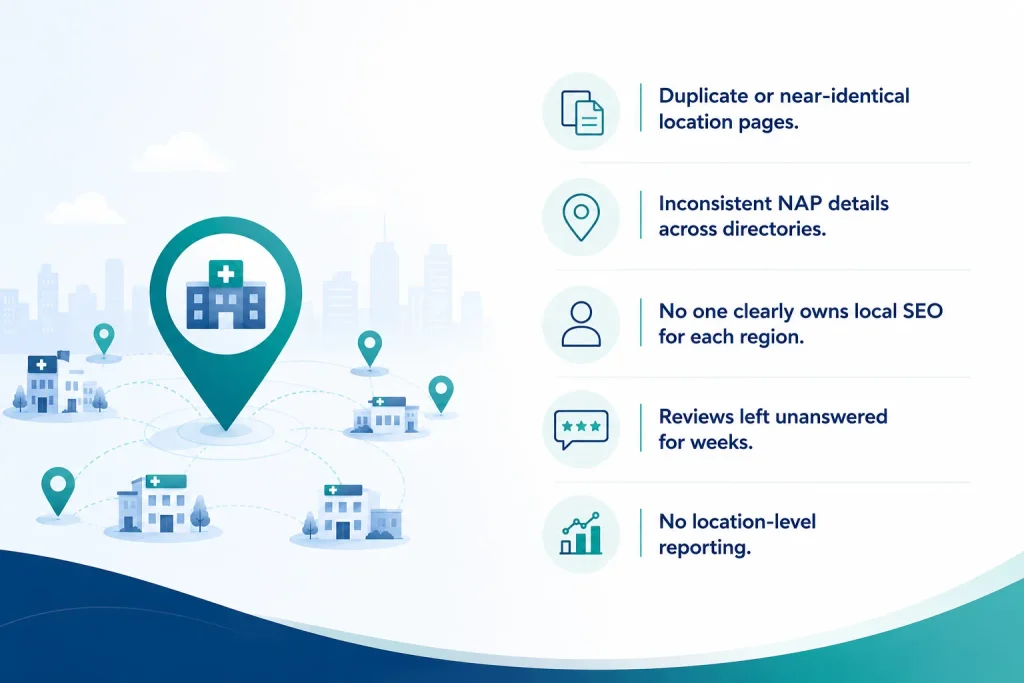
Duplicate or near-identical location pages.
Copying one page and swapping the city name rarely fools Google, and it does not help a patient looking for something locally relevant either.
Inconsistent NAP details across directories.
As covered above, this quietly wears down trust with search engines, often before it becomes obvious to a person.
No one clearly owns local SEO for each region.
When everyone is responsible, no one really is, and profiles fall out of date.
Reviews left unanswered for weeks.
One ignored complaint at a single branch can shape how a patient sees every other branch in the brand.
No location-level reporting.
Blended, brand-wide numbers hide which clinics actually need help, and by the time it is obvious, that clinic may have been struggling for months.
None of this means a brand is badly run. It is simply what happens when a system built for one location gets stretched across many, without ever being rebuilt for that scale.
How Healthus.ai Helps Multi-Location Healthcare Brands Win Local Search Everywhere They Operate
Healthus.ai treats every clinic location as its own local SEO project while keeping the whole brand coordinated from one dashboard. That way, a hundred clinic brand gets the same care a single clinic would get, at every branch. This is the idea behind the healthcare local SEO service Healthus.ai runs for hospital groups, clinic chains, and multi-city practices.
In practice, this means setting up, verifying, and managing Google Business Profiles for every location, not just the main one. It means regular NAP checks across every directory your brand appears on. It means unique, locally written pages for each clinic, built on a template that can scale. And it means centralised review and reputation management, so no branch’s feedback goes unanswered.
This work is handled by a team that focuses only on healthcare, and that matters. A multi-location dental chain, a diagnostics network, and a multi-city hospital group each need slightly different judgement calls, not one template borrowed from retail. You can read more about how this approach developed on Healthus.ai’s own story, or see the wider healthcare SEO work it fits into.
If you are already managing ten, fifty, or a hundred-plus locations and feeling the weight of doing it by hand, you do not need to fix everything overnight. And you do not have to do it alone.
Conclusion
Local SEO for multiple locations is not a bigger version of single clinic SEO. It is a coordination problem. Once you see it that way, ten clinics, fifty clinics, or a hundred stop feeling unmanageable. The brands that get this right are not always the ones with the biggest teams, rather they are the ones with a system that treats every single location like it matters, because to the patient standing outside that clinic, it is the only one that does.
If you want that kind of order for your own multi-location local SEO, Healthus.ai works with healthcare brands managing exactly this kind of scale. Get in touch to see what consistent, clinic-by-clinic visibility could look like across every location you run.
References
Grajales, F.J., Sheps, S. and Ho, K. (2014) ‘Social media: a review and tutorial of applications in medicine and health care‘, Journal of Medical Internet Research, 16(2), p. e13.
Han, X., Lin, Y., Han, W., Liao, K. and Mei, K. (2024) ‘Effect of negative online reviews and physician responses on health consumers’ choice: experimental study‘, Journal of Medical Internet Research, 26, p. e46713.
Rosenlund, M., Turja, T., Jylhä, V., Saranto, K. and Kuusisto, H. (2026) ‘Experiences of decision-making in healthcare and online health information-seeking among older adults and people with long-term disease: online survey study‘, Journal of Patient Experience.
Frequently Asked Questions (FAQs)
Local SEO for multiple locations is the practice of helping every branch of a healthcare brand, not just the main website, show up in search when patients nearby are looking for care, so each location can be found, trusted, and chosen on its own.
Regular local SEO focuses on ranking one business in one area. Multi-location SEO has to do that for every branch at once while making sure locations do not compete against each other for the same search terms and still feel like one consistent, trustworthy brand.
Generally, one dedicated page per physical clinic, built on a consistent template but filled with genuinely unique, locally relevant content for that branch, rather than one shared page trying to represent every location at once.
NAP consistency means a clinic’s Name, Address, and Phone number appear exactly the same across every website, directory, and profile it is listed on. Search engines use that consistency as a trust signal, so mismatches, even small ones, can quietly hurt a location’s ranking.
Through clear ownership, one person or team responsible for each region, verified and claimed profiles under the brand’s own account, and a regular audit to catch outdated hours, wrong details, or unanswered messages before they affect patients.
Yes, at a smaller scale, ten clinics or fewer, it is possible to manage this with clear ownership and a simple checklist. Past that point, most healthcare brands find the coordination work grows faster than any internal team can absorb alongside its regular responsibilities