





In brief
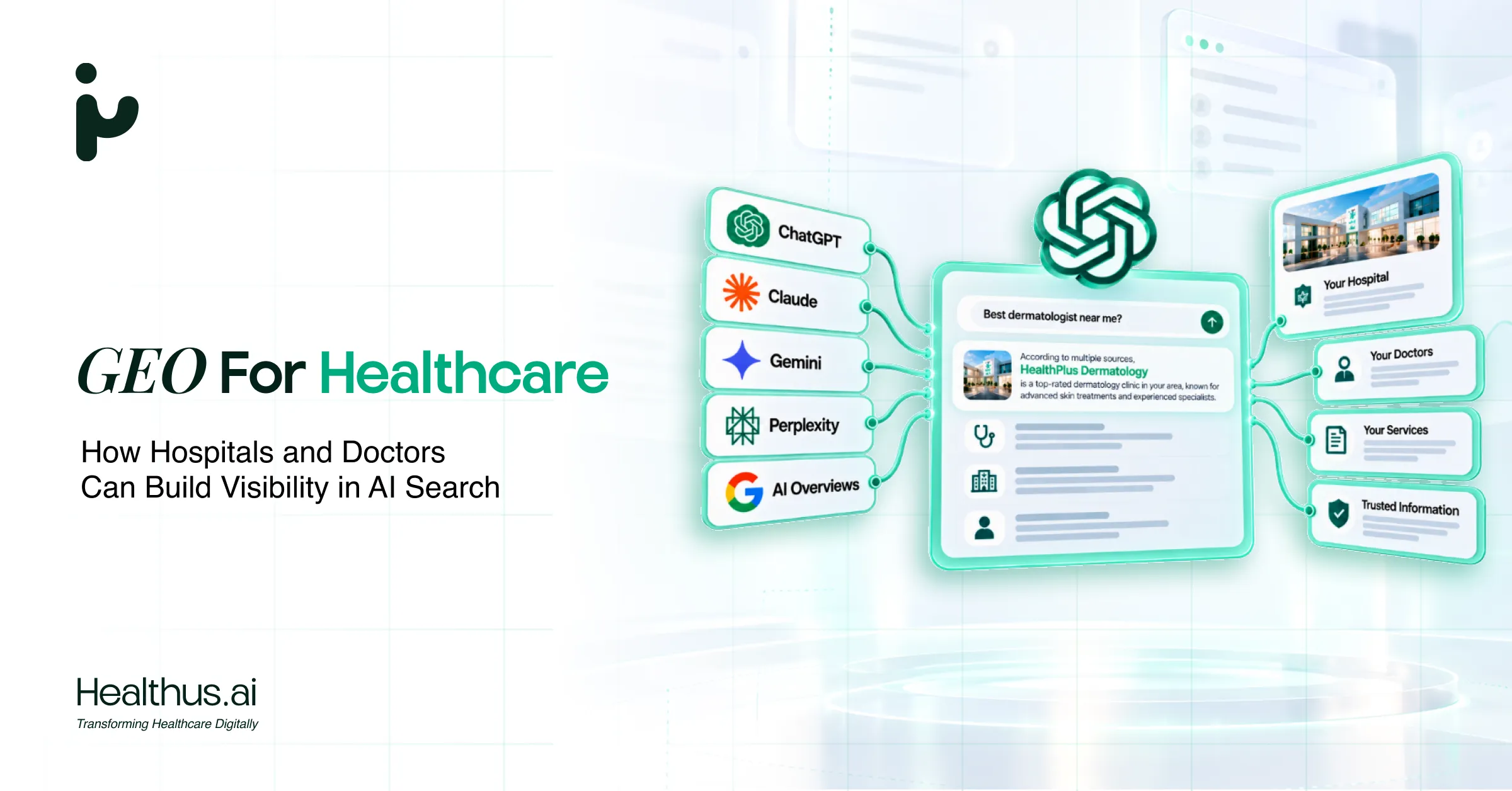
GEO, or Generative Engine Optimisation, looks at how content becomes visible or cited when AI tools generate answers. For healthcare brands, that does not mean replacing SEO with a new set of tricks. The focus is still on making reliable information easy to find, understand and reference across the AI platforms patients increasingly use.
What Does GEO Mean in Healthcare?
Generative Engine Optimisation, or GEO, is the idea of improving how content appears in answers produced by generative search and AI tools. For hospitals and doctors, the practical point is simple. Visibility no longer happens only on a traditional search results page. A patient may also find a hospital through a cited source or link inside an AI answer.
There is no fixed “AI ranking formula”, though. A 2026 review found wide variation across GEO studies and did not identify one technique with a stable, long-term effect across platforms (Martinez, 2026).
How Is GEO Different From Healthcare SEO?
SEO and GEO overlap heavily.
Healthcare SEO helps useful pages become discoverable in search results. If you need the wider SEO foundation first, our guide to healthcare SEO covers how healthcare organisations build organic visibility through technical, content and local search work.
GEO asks an additional question: when an AI tool builds an answer, is your information among the sources it can find and use? GEO also sits alongside approaches such as AEO. Our guide to AEO in local healthcare SEO looks at how answer-led content fits into healthcare search visibility.
Microsoft describes this newer layer in terms of citations and “grounding”, which refers to the web sources used to support an AI-generated answer (Microsoft, 2026a).
For a hospital, GEO still depends on familiar basics: accessible pages, accurate information and content worth referring to.
AI Search Platforms Do Not All Find Content the Same Way
“AI search” sounds like one channel, but the platforms work differently.
| Platform | What its guidance says | What to check |
| ChatGPT Search | OAI-SearchBot supports search-related discovery | Make sure it is not blocked by mistake |
| Perplexity | PerplexityBot is used to surface and link websites | Check robots.txt and crawler access |
| Microsoft Copilot | Some web-enabled experiences use Bing Search | Check Bing indexing and Webmaster Tools |
OpenAI says public websites can appear in ChatGPT search and recommends allowing OAI-SearchBot if publishers want content to be discovered, cited and linked (OpenAI, 2026). Perplexity publishes similar guidance for PerplexityBot (Perplexity, n.d.). Microsoft says some Copilot experiences may use Bing Search for current web information (Microsoft, 2026c).
Check That AI Search Tools Can Reach Your Site
OpenAI advises publishers not to block OAI-SearchBot if they want their content to be eligible for ChatGPT search. It treats the issue separately from GPTBot, which relates to potential model training. A website can therefore allow search discovery while making a different choice about training access (OpenAI, 2026).
Perplexity also publishes separate crawler guidance. PerplexityBot is used for search discovery, while Perplexity-User may visit a page in response to a user request (Perplexity, n.d.).
For a hospital website, check the robots.txt file, firewall rules, and other access settings before assuming that weak AI visibility is a content problem.
Build Healthcare Content That Is Worth Referencing
Being accessible is only the first step. The page still needs to be useful.
A hospital service page should explain what that hospital actually offers. A medical article should answer the reader’s question clearly, use appropriate evidence and involve qualified clinical input where needed.
Original information can help too. That may include which specialists provide a service, where it is available, how appointments are organised or what patients can expect when they contact the hospital. For more on preparing the content itself for generative search: see our guide to optimising healthcare content for AI search engines.
These are healthcare-content standards first. Healthus requires important medical claims to be supported and higher-risk content to receive appropriate review because patients may act on what they read. We should not present those safeguards as a secret ChatGPT or Perplexity ranking factor.
Our guide to E-E-A-T in healthcare content explains how to make expertise, authorship, and trust clearer on medical webpages.
Want to understand how visible your healthcare brand is across search and emerging AI platforms? Start with a focused review.
Keep Doctor, Service and Location Information Consistent
Hospitals often have the same information spread across websites, doctor profiles, directories and location pages. Over time, those details can drift.
A doctor’s speciality may be updated on one page but not another. A service may move while an older page still shows the previous location.
Check clinician names and credentials, services, locations and contact details across the properties you control. Consistency does not guarantee an AI citation, but contradictory information is worth fixing wherever patients may find it.
These consistency checks also support the foundations of local SEO for doctors and clinics, particularly where healthcare organisations operate across multiple locations.
Do You Need Different Content for ChatGPT, Perplexity and Copilot?
Usually, no.
Different platforms may have different crawler or indexing requirements. That does not mean a hospital needs a “ChatGPT version” and a “Perplexity version” of the same medical page.
The evidence is still too mixed to support that approach. A 2026 review of 45 studies found substantial differences in methods and outcomes and did not identify a technique with a stable cross-platform effect on organic visibility or later user behaviour (Martinez, 2026).
Maintaining one accurate, useful source of information is a more sensible starting point.
How Can Healthcare Brands Measure GEO Visibility?
There is no single dashboard for AI search performance.
OpenAI adds utm_source=chatgpt.com to links from the ChatGPT search. This is a tracking tag in the URL that can help analytics teams identify visits from ChatGPT (OpenAI, 2026).
Microsoft’s AI Performance report in Bing Webmaster Tools can show citations, cited pages and trends across supported Microsoft AI experiences (Microsoft, 2026b). Microsoft also says these figures are not a ranking or authority score.
Neither metric tells a hospital whether someone went on to book an appointment. Where tracking allows it, look at AI visibility alongside referral visits, enquiries, appointment actions and qualified leads.
GEO metrics become more useful when they are tied back to business outcomes. Our guide to healthcare SEO ROI shows how visibility can lead to enquiries, appointments and revenue when appropriate tracking exists.
GEO Claims Healthcare Teams Should Be Careful With
AI search has developed quickly, and some of the language around it has moved faster than the evidence.
| Claim | A more useful way to look at it |
| “We can rank your hospital #1 in ChatGPT” | AI answers are dynamic, and platforms do not publish a fixed #1 ranking system comparable with a traditional search results page |
| “One GEO score shows your true AI visibility” | Third-party scores can be useful monitoring indicators, but they are not universal platform metrics |
| “One crawler setting covers every AI engine” | OpenAI, Perplexity and Microsoft use different discovery systems |
| “Every page needs to be rewritten for AI” | Current evidence does not establish a universal AI-specific writing format |
| “More AI citations automatically mean more patients” | Citation visibility and patient acquisition are separate outcomes and should be measured separately |
Practical Healthcare GEO Checklist
Before investing in a new GEO tool or rewriting a website, check the basics:
- Can relevant search crawlers reach the pages you want discovered?
- Are important medical claims supported by appropriate sources?
- Does the content include genuine clinical or first-party information?
- Are doctors, services and locations clearly identified and consistent?
- Are time-sensitive pages reviewed when needed?
- Are AI citations or referral visits being tracked where possible?
- Can visibility be connected with enquiries, appointments or another meaningful action?
Build GEO on a Strong Healthcare Search Foundation
AI search gives patients more ways to come across a hospital, doctor or piece of health information. The fundamentals still matter: reliable webpages, sound SEO and genuinely useful content.
The practical approach is to make trustworthy information accessible, understand how different platforms find it and measure what happens afterwards.
Strengthen how your healthcare brand is discovered across traditional and AI-powered search.
Doctors and clinic teams looking at the wider patient-acquisition journey can also explore our guide to building a stronger digital presence for a medical practice.
References
Martinez, O. (2026) Optimizing Visibility in Generative Engines: A Critical Survey of Generative Engine Optimization (2023–2026). arXiv. Available at: https://arxiv.org/abs/2607.14035
Microsoft (2026a) Elevating the Role of Grounding on the AI Web. Bing Search Blog, 12 February. Available at: https://blogs.bing.com/search/February-2026/Elevating-the-Role-of-Grounding-on-the-AI-Web
Microsoft (2026b) Introducing AI Performance in Bing Webmaster Tools Public Preview. Bing Webmaster Blog, 10 February. Available at: https://blogs.bing.com/webmaster/February-2026/Introducing-AI-Performance-in-Bing-Webmaster-Tools-Public-Preview
Microsoft (2026c) Data, privacy, and security for web search in Microsoft Copilot and Microsoft Copilot Chat. Microsoft Learn. Available at: https://learn.microsoft.com/en-us/microsoft-365/copilot/manage-public-web-access
OpenAI (2026) Publishers and Developers – FAQ. OpenAI Help Center. Available at: https://help.openai.com/en/articles/12627856
Perplexity (n.d.) Perplexity Crawlers. Perplexity Documentation. Available at: https://docs.perplexity.ai/docs/resources/perplexity-crawlers
Frequently Asked Questions (FAQs)
GEO, or Generative Engine Optimisation, looks at how healthcare information is discovered, referenced or cited in generative AI answers. It overlaps with SEO but also considers visibility inside AI-powered search experiences.
There is no guaranteed placement. OpenAI says public websites can appear in ChatGPT search and recommends allowing OAI-SearchBot if publishers want content to be eligible for discovery, citation and linking (OpenAI, 2026).
No. OpenAI treats GPTBot and OAI-SearchBot differently. OAI-SearchBot is relevant to search discovery, while GPTBot relates to potential model training (OpenAI, 2026).
It depends on the platform. ChatGPT referral visits can be identified through its URL tracking tag, while Bing Webmaster Tools provides AI citation reporting for supported Microsoft experiences. Review these signals alongside enquiries, appointments and other conversion data (OpenAI, 2026; Microsoft, 2026b).